Freshly ground powder rarely stays as single particles. The fines carry fresh surfaces and electrostatic charges, and they cling into clusters the moment the mill releases them. An air classifier then sees a coarse particle where a fine one actually is. The result is a familiar pair of symptoms, because a D100 overrun and a falling yield arrive together. This article explains why particle agglomeration forms in a dry circuit. It then shows how clusters defeat the cut point, and which levers restore the split. The working principle behind the split is described in our guide to air classifier working principle and applications.
Why Fines Cling Together
Three forces hold a cluster together. Van der Waals attraction acts on every dry surface, and its effect grows as particles shrink. The reason is geometric, because surface area rises while mass falls. Fracture also leaves fresh surfaces charged, and oppositely charged grains attract. Moisture adds the third force. A thin liquid film bridges two particles the way glue does. Materials differ in how hard they suffer. Graphite, metal oxides, and lamellar minerals carry high surface activity. Plants that grind them watch clusters form between the mill and the classifier. The finer the target, the stronger the grip, because a finer cut means more surface and less mass per grain.
How a Cluster Defeats the Cut Point
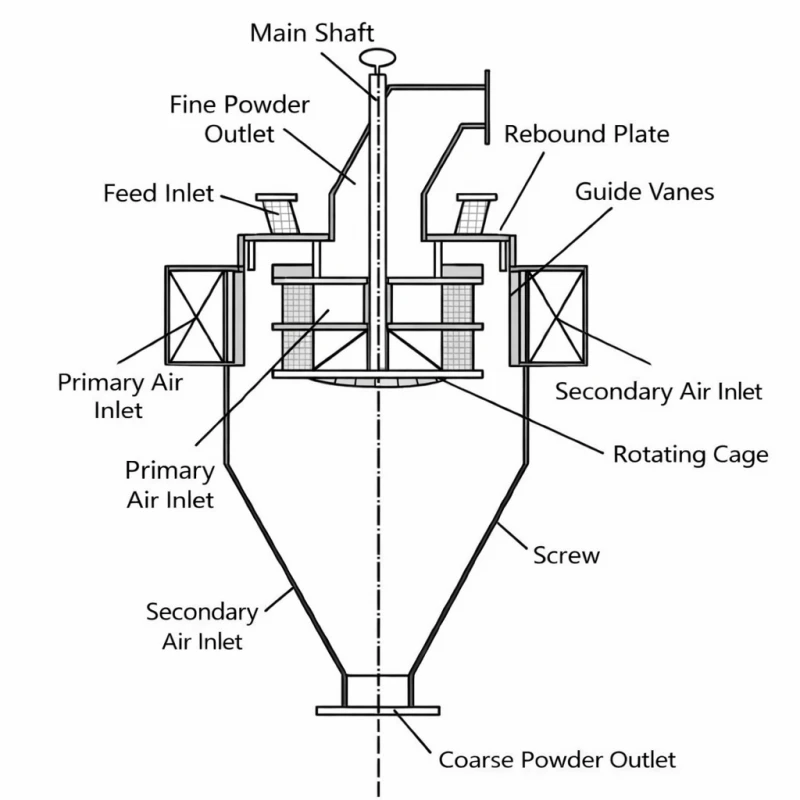
A turbo wheel sorts by the aerodynamic size of whatever reaches it. A cluster of three 2 µm grains behaves like a single 6 µm grain. The wheel therefore returns it with the true coarse fraction. The cluster breaks inside the circuit and reforms again, and the recirculating load climbs. D100 readings drift past the target even while the mill grinds finer. The wheel is usually blamed first, and the blame usually lands on the wrong variable. Our troubleshooting guide to coarse carryover in negative electrode graphite walks through that diagnosis step by step. The wheel itself is described in depth in our guide to classifier wheels. That guide separates what wheel speed controls from what it cannot reach.
The Symptoms in a Running Plant
Agglomeration announces itself through three coupled symptoms. Yield falls, because clusters leave with the coarse stream. The fine product then runs lean against its own specification. Part of the true fines never exits the circuit, and that is the shortfall. Energy per ton rises, because the mill grinds the same particles again and again. The reflex fix is a higher wheel speed, and the reflex often deepens the loss. Our article on rotor speed and coarse particle separation explains the mechanism. An aggressive cut raises recirculation, and the split blurs further. Operators who chase the D100 with wheel speed alone end up chasing yield next.
Levers That Break the Clusters
The countermeasures follow from the three forces, and the table lists them with the symptom each one answers.
| Cause | Symptom | Countermeasure |
|---|---|---|
| Feed moisture film | Clusters form at the feed point | Dry the feed, run hot gas in the circuit |
| High fines share in feed | Recirculating load climbs | Coarser upstream mill setting, staged classification |
| Poor dispersion at entry | D100 overrun with clean mill product | Scattering disc, secondary air at the feed point |
| Over-high wheel speed | Yield collapse at unchanged cut | Moderate wheel speed with larger air volume |
Moisture is the cheapest lever, and it works first. A feed that arrives dry sheds the liquid bridges before they form. Dispersion does the rest. The feed point deserves as much attention as the wheel. A cluster that survives the feed chute reaches the wheel as a false coarse grain. Staged classification gives the second lever. A first pass at a coarser cut removes the true coarse particles. A second pass then handles the fines against a lighter load. Dispersion, moisture, and load belong in one plan, because the three forces answer different levers.
Where a Trial Decides
Storage also deserves attention. Fresh ultrafine powder agglomerates further in silos and bags. A product that left the classifier clean can still arrive coarse at the customer. Plants that pack promptly avoid that return path. Plants that store run the risk again, and the moisture in storage drives it.
Agglomeration strength is a material property, and no table predicts it. A useful trial disperses the feed, runs two wheel speeds, and measures the coarse stream under forced dispersion. The comparison separates true coarse particles from clusters. The yield numbers then describe the real machine. Our air classifier selection guide lists the dimensions that separate one system from another. Agglomeration behavior belongs at the top of that list for cohesive powders. A quotation written without that number is a guess wearing a specification.
FAQ
Does grinding finer fix agglomeration?
Grinding finer raises the surface area in play. Clusters then form more readily at the same moisture. The mill is the wrong lever for a classification problem. Dispersion and moisture control attack the cause. The wheel setting then holds the cut that the material allows.
Can moisture alone cause coarse carryover?
A thin liquid film bridges particles on contact. In hygroscopic powders, a few percentage points of moisture can dominate that balance. Drying the feed is the first and cheapest step for that reason. Plants that fixed carryover with heat alone prove the point every season.
How do you tell a cluster from a true coarse particle?
Measure the coarse stream twice, once dry and once under forced dispersion. Clusters break under dispersion and disappear from the distribution. True grains hold their size. The gap between the two curves is the agglomeration share. The trial reports it as a number.
Epic Powder
Epic Powder designs grinding and classifying systems for minerals, chemicals, food, and pharmaceuticals. With more than 20 years of powder processing experience, we match the right mill to your target particle size and capacity. Tell us about your material and we will recommend a tested solution.

“Thanks for reading. I hope my article helps. Please leave a comment down below. You may also contact EPIC Powder online customer representative Molly for any further inquiries.”
— Written by Emily Chen