A company spends millions upgrading a grinding line. Acceptance test comes back clean. D50 is right on target. Three months later, downstream customers are calling about batch color inconsistency, unstable dispersion, film surface defects.
The problem usually is not the mill. It is the classification system. Specifically, dynamic stability and cutting sharpness get overlooked during equipment selection, and once production scales up, D97 starts drifting. Grinding decides whether you can make powder fine enough. Classification decides whether you can make it consistently, efficiently, and profitably. That difference is what separates a premium product from a commodity.
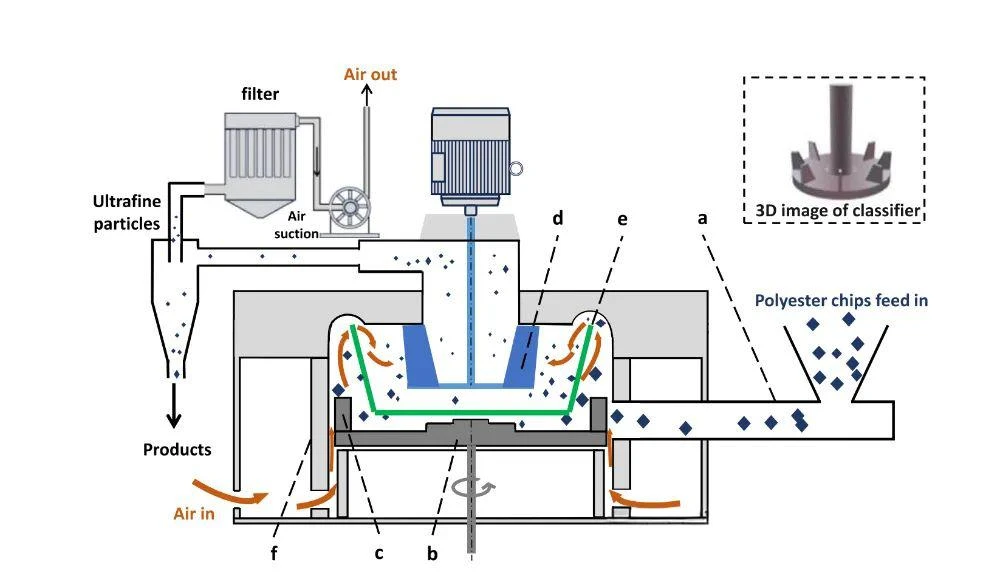
Here are the five engineering dimensions to check when selecting an air classifier for a dry powder processing line.
Distribution Width (D97/D50): Watch for Tail Coarse Particles
Most buyers and engineers look at D50 first. D50 is a median, which hides the largest particles sitting in the tail of the distribution. What matters for downstream performance, think dispersion quality, gloss, film flatness, is the width of the particle size distribution. The standard way to measure this is the D97/D50 ratio.
The closer that ratio is to 1.0, the narrower the distribution and the more consistent the product. For high-end non-metallic mineral powders and battery materials, you want this ratio between 2.0 and 2.5. If a supplier tells you D50 = 5 microns but avoids mentioning that D97 = 15 microns, that is tail coarse leakage. It will ruin performance in demanding applications.
How to check
Get the full laser diffraction report. Not just the D50 number. EPIC Powder’s multi-rotor air classifiers are built around tight distribution control and deliver consistent D97/D50 ratios across production batches.
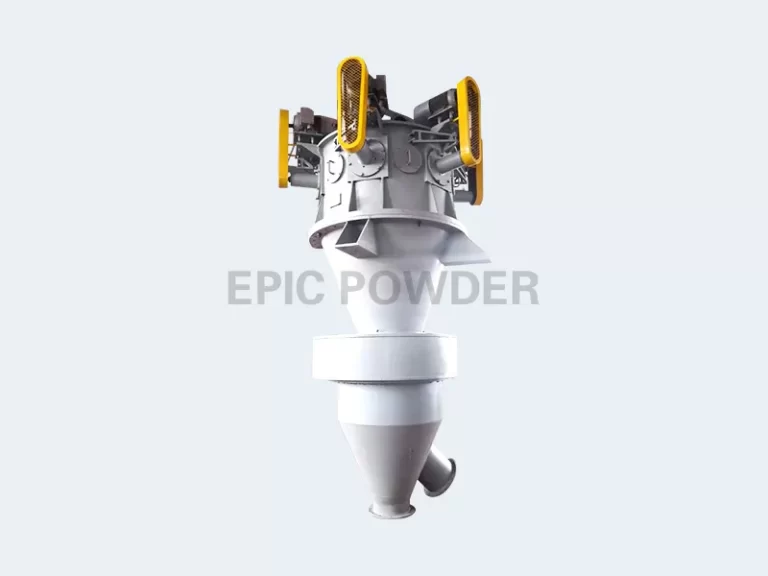
(Product page: https://www.powder-air-classifier.com/machines/air-classifier-hts/multi-rotor-air-classifier/)
Cutting Sharpness
A good classification cut should be sharp. When precision is poor, fine powder gets mixed with coarse particles, and coarse product carries too many fines. That raises internal recirculation load and wastes energy. Engineers measure cutting sharpness through the Tromp curve (partition curve) steepness or Newton classification efficiency. A steeper Tromp curve means the classifier makes a cleaner cut at the target particle size.
How to check
Ask the supplier for their measured Tromp curve or classification efficiency data. A well-designed system matches the flow field to the rotor blade geometry precisely. With CFD flow field simulation, optimized classifier wheel shapes eliminate local vortices at the rotor edges. That alone can improve classification accuracy by more than 20%. EPIC Powder’s ITC air classifying systems and TDC twin classifiers are designed around this kind of flow-field-to-rotor matching.
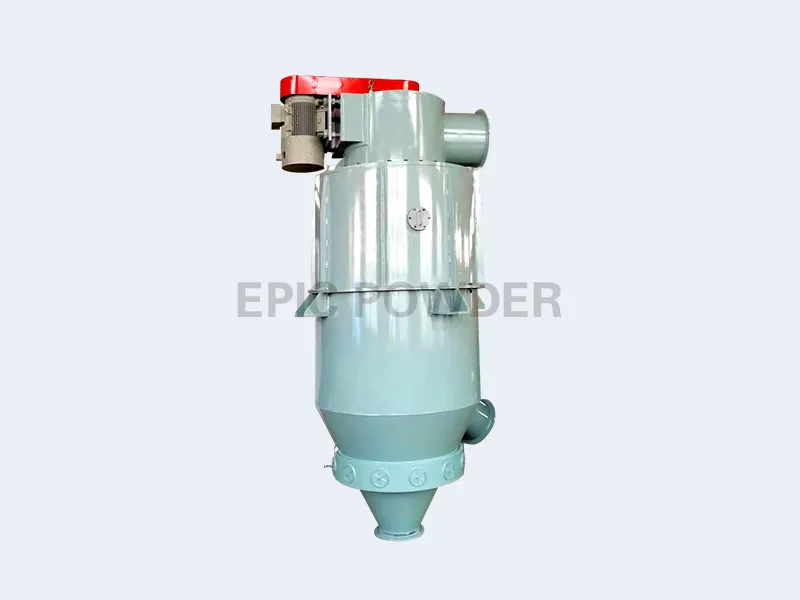
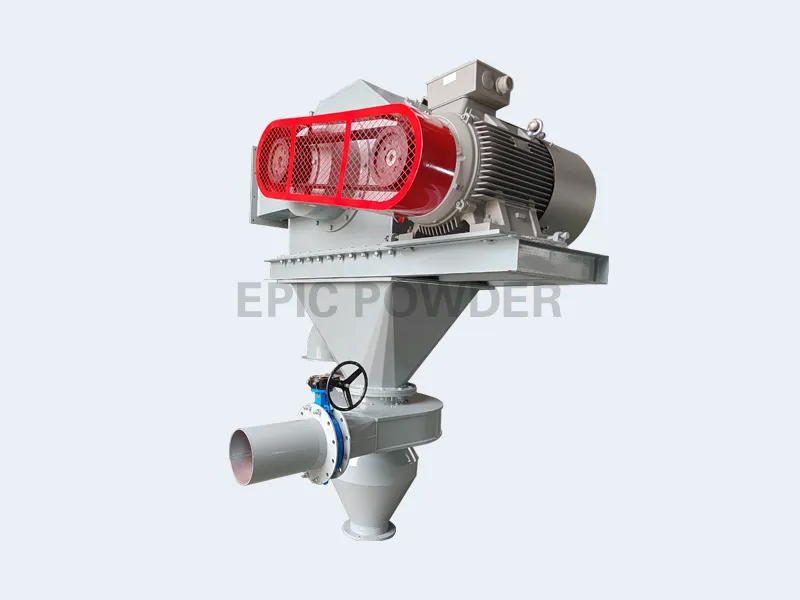
(ITC: https://www.powder-air-classifier.com/machines/air-classifying-itc/)
(TDC: https://www.powder-air-classifier.com/machines/turbo-twin-double-classifier-tdc/)
Yield Rate vs. Over-Grinding: Calculate the Real Economics
An air classifier has two jobs: classify accurately, and discharge qualified fines fast. Getting on-spec powder out of the system quickly is what prevents over-grinding. Over-grinding costs more than electricity. It breaks down the natural crystal structure of the material. Talc loses its lamellar form. Wollastonite loses its needle shape. In high-end applications, morphology is half the product value.
How to check
Compare energy consumption per ton and system throughput at the same fineness target. A common mistake is closing dampers and pushing rotor speed to chase a finer D97. That traps fine powder in endless recirculation. The benchmark: at target fineness, one-pass classification yield should be 85% or higher. That is the balance point between output and quality. EPIC Powder’s MBS powder separators are designed for high-efficiency fine powder extraction specifically to cut over-grinding losses.
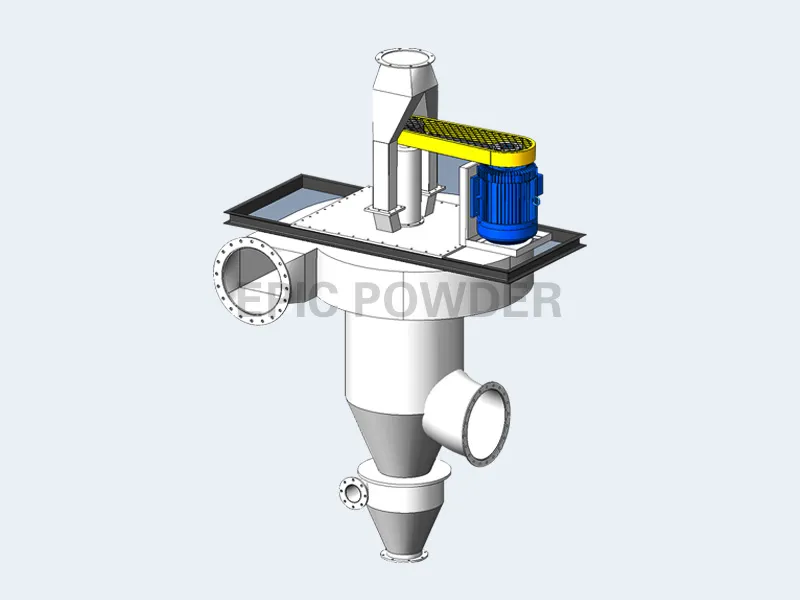
(MBS: https://www.powder-air-classifier.com/machines/powder-air-separator-mbs/)
Dynamic Stability: Long-Run Performance Reveals the Truth
Lab data and first-hour startup numbers do not mean much for production planning. The measurement that matters is D97 fluctuation after 72 hours, 720 hours, and longer of continuous operation. That is where mechanical precision, bearing temperature control, and flow field design get tested.
Standard classifiers tend to drift after about 24 hours. Thermal expansion and spindle runout shift the clearances, and the cut point moves. Once the particle size distribution starts wandering, the whole batch is affected. Downstream customers notice right away.
How to check
Do not accept a single-point acceptance test as proof. Ask for D97 fluctuation data under full load, continuous operation. High-end classification systems with precision bearing cooling and thermal clearance compensation keep D97 fluctuation within plus or minus 1.5% over 72 hours of non-stop running. That level of stability is what separates reliable industrial equipment from something that only works in the lab. EPIC Powder’s CTC centrifugal classifiers are built for sustained long-run precision.
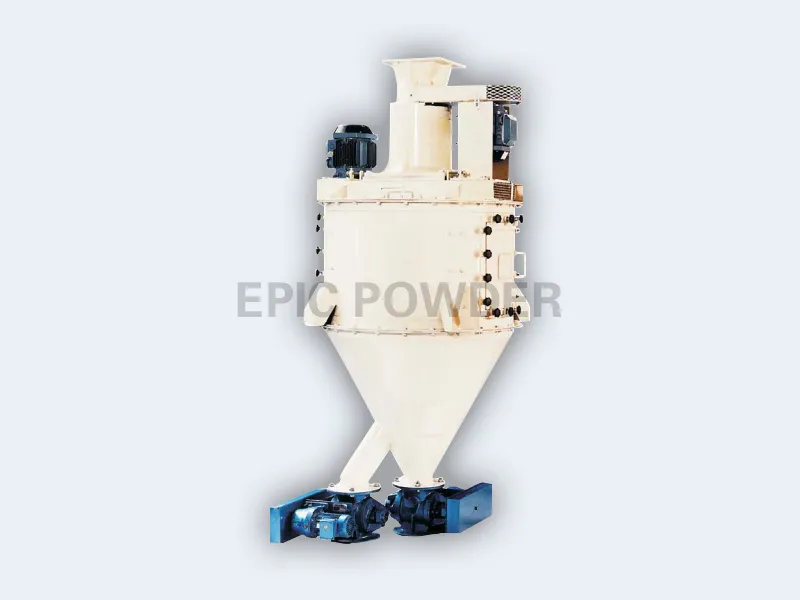
(CTC: https://www.powder-air-classifier.com/machines/centrifugal-classifier-ctc/)
System Linkage Response: One Strong Machine Cannot Beat One Smart System
A classifier never runs alone. It has to form a closed loop with the upstream mill’s grinding concentration, the system air volume, and the induced draft fan’s negative pressure. When the mill’s internal load changes and the classifier parameters do not respond in real time, the system loses balance immediately. You get coarse leakage or material blockage.
This is probably the most overlooked dimension in classifier selection, and it is often why production lines never reach their design capacity.
How to check
Look at the control system’s automation logic. A properly designed system uses a PLC control hub that continuously reads real-time mill load and air pressure data, then automatically adjusts classifier rotor speed and feed rate. The response happens at millisecond speed. This kind of synchronized system-level control is something you cannot get by buying machines from different suppliers and wiring them together.
Premium System vs. Standard System: Key Parameter Comparison
Dimension Metric Premium System VS. Standard System
- Distribution Width D97/D50 Ratio 2.02.5 3.05.0+
- Cutting Sharpness Classification Accuracy 20%+ via CFD optimization No CFD optimization
- Yield Rate One-Pass Classification Yield 85% or higher 60~75%
- Dynamic Stability D97 Fluctuation (72h) plus/minus 1.5% plus/minus 5% or worse
- System Linkage Control Response Millisecond PLC closed-loop Manual or basic PID only
Why Piecemeal Assembly Fails in Powder Engineering
Powder processing is systems engineering. Looking at a single classifier’s spec sheet tells you almost nothing about how it will perform in a real production line.
Too many plants do this: buy a mill from Supplier A, a classifier from Supplier B, a dust collector from Supplier C. Then they spend months trying to figure out why the line never reaches nameplate capacity. The answer is usually air resistance mismatch and concentration control disconnection. The components work against each other instead of with each other.
The real barrier in powder processing is not any individual machine. It is the unified control of the whole line, from flow field simulation and air circuit design through to automation logic.
At EPIC Powder Machinery, we have been in ultrafine powder processing for over 20 years. We design and build complete classification systems. Every component, multi-rotor classifiers, ITC classifiers, CTC centrifugals, TDC twins, MBS separators, is engineered to work together under a single control architecture. That is how you get all five dimensions to perform at the same time.
EPIC Powder Air Classifier Range
Multi-rotor Air Classifier HTS D97: 3~45 microns, ultra-fine precision
https://www.powder-air-classifier.com/machines/air-classifier-hts/multi-rotor-air-classifier/
Air Classifying ITC D97: 5~200 microns, versatile dry classification
https://www.powder-air-classifier.com/machines/air-classifying-itc/
Centrifugal Classifier CTC 32~250 microns, coarse particle separation
https://www.powder-air-classifier.com/machines/centrifugal-classifier-ctc/
Turbo-Twin Double Classifier TDC High-speed precision cutting
https://www.powder-air-classifier.com/machines/turbo-twin-double-classifier-tdc/
Powder Separator MBS D97: 8~200 microns, efficient separation
https://www.powder-air-classifier.com/machines/powder-air-separator-mbs/
Key Takeaways
- D50 alone is misleading. Always check the D97/D50 ratio for actual distribution width.
- Demand Tromp curve data to verify cutting sharpness and classification precision.
- One-pass yield of 85% or higher is the benchmark for economic classification.
- Test beyond the first hour. D97 stability over 72+ hours is the real metric.
- System integration matters more than any single machine spec. Choose a supplier with unified whole-line design capability.
Frequently Asked Questions
Q: What is the difference between D50 and D97 in powder classification?
A: D50 is the median particle size. 50% of particles are smaller than this value. D97 means 97% of particles are smaller than this value. D97 exposes the oversized “tail” particles that D50 hides, and these coarse particles are usually what cause downstream application failures.
Q: How do I choose between a multi-rotor and single-rotor air classifier?
A: Multi-rotor classifiers (like EPIC’s HTS series) provide more classifying surface area and work well for ultra-fine applications needing D97 of 345 microns at high throughput. Single-rotor classifiers (like the ITC series) are versatile machines for D97 ranges of 5200 microns and are easier to maintain.
Q: What causes particle size drift during long production runs?
A: Thermal expansion of rotor components and spindle bearing runout are the main causes. As the classifier heats up, internal clearances change and the cut point shifts. Premium systems handle this through active bearing cooling and thermal compensation.
Q: Can EPIC Powder provide customized air classifier solutions?
A: Yes. EPIC Powder Machinery works on a “one customer, one design” approach. We tailor each classification system to your material, throughput, and quality targets. Send us your material specs and we will provide a technical proposal within 24 hours.
Need Help Selecting an Air Classifier?
Tell us about your material, target particle size, and capacity requirements. Our engineering team will provide a tailored classification solution within 24 hours.
Contact EPIC Powder Machinery:
Website: https://www.powder-air-classifier.com
Phone: +86-157 6227 2120
Address: NO. 369, Road S209, Huanxiu, Qingdao City, China

“Thanks for reading. I hope my article helps. Please leave a comment down below. You may also contact EPIC Powder online customer representative Zelda for any further inquiries.”
— Jason Wang, Engineer