When coarse particles mix into the fine fraction after classifying negative electrode graphite, the industry calls it “coarse carryover”. This is a common issue on air classifiers and turbo classifiers in the field, yet it directly hurts the batch consistency of lithium-ion anode materials. This article serves two audiences: plant process engineers who need a step-by-step troubleshooting path, and procurement teams who want to avoid buying equipment that is prone to coarse carryover on graphite lines.
1. Symptoms and consequences of coarse carryover
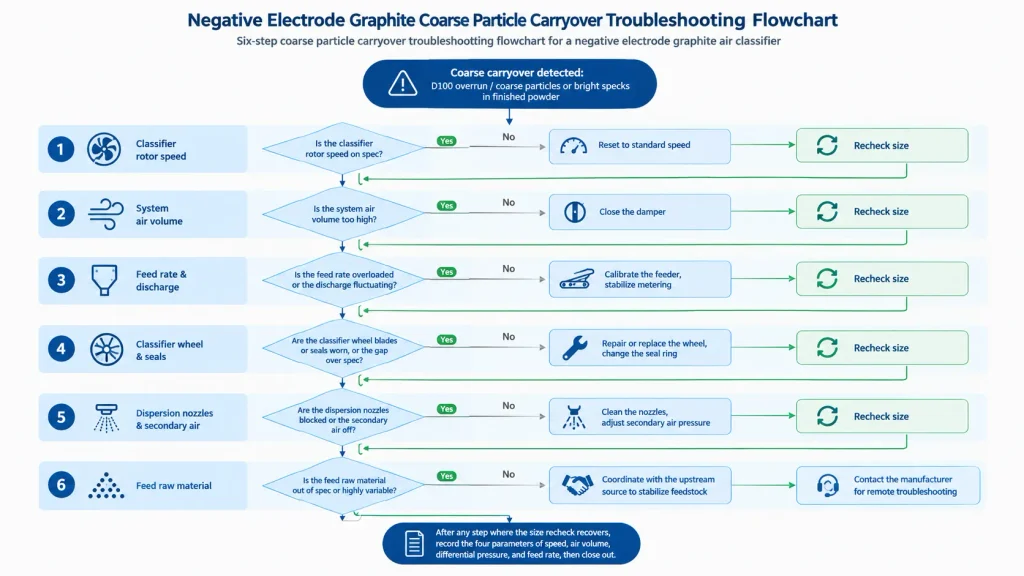
The most direct way to confirm coarse carryover is to check the particle size distribution. In properly classified negative electrode graphite, D50 should stay stable within roughly 10 to 25 μm, and the D90 and D100 values should remain under control. If D100 shifts clearly upward, or if coarse particles and bright specks keep showing up in the finished powder, coarse particles are slipping past the classifying wheel. Once carryover happens, coating often shows scratches and uneven electrode compaction, followed by higher internal resistance and capacity fluctuation. Take a few samples and measure the size distribution; if D100 jumps around, the problem is usually equipment condition or process parameters rather than the raw material.
2. Six common causes of coarse carryover
Ranked by how often they appear in the field, there are six main causes. Where a cause links to equipment selection, the buying considerations are noted alongside.
Cause one, classifier rotor speed too low. The classifying wheel relies on centrifugal force to throw coarse particles back into the classification zone. When speed is too low, the cut point gets larger and coarse particles ride the airflow into the fine outlet. When buying, check the maximum tip speed of the classifying wheel and the range of frequency adjustment, and leave enough headroom.
Cause two, system air volume too high. Higher airflow increases carrying capacity, pulling out large particles that should fall back into the classification zone. Any operating condition where airflow has been raised comes with a higher carryover risk.
Cause three, feed rate overload. Too much feed raises the solid-to-gas ratio in the classification zone, particles interfere with each other, and coarse particles slip through the classifying wheel. Feed system stability determines how often this problem recurs.
Cause four, classifier wheel and seal wear. After long service, the gap between the blades and the seal ring widens, letting coarse particles leak through. This is the most hidden cause and is easily confused with speed or airflow issues. When buying, pay close attention to the wear treatment of the classifying wheel and the sealing method.
Cause five, poor material dispersion. Graphite is light and tends to agglomerate. If the dispersion nozzle clogs or the secondary air is off, agglomerates pass through the classifying wheel as if they were fine particles.
Cause six, raw material too coarse or inconsistent. If upstream crushing is not controlled and the feed exceeds the classifier’s design limit, downstream adjustment is always a struggle. Confirm the feed size range before buying to avoid selecting the wrong machine.
3. Six troubleshooting steps, from easy to hard
Start with the rotor speed. Compare against the process sheet and confirm the actual speed matches the set value, ruling out inverter faults and belt slip. When the cut size runs large, reset to the standard speed first and recheck.
Then check airflow and differential pressure. Look at the main fan damper opening and the system differential pressure, and compare with the last normal production run. If airflow is high, close the damper and watch whether D100 comes back down. As a reference, for fine classification of negative electrode graphite the classifier wheel tip speed generally falls in the 40 to 90 m/s range; the process sheet is the final authority.
Next, verify the feed rate. Check whether the feeder is calibrated and the discharge is even. Intermittent carryover is often tied to fluctuation in metering.
Then inspect the classifier wheel and seals. After shutdown, check blade wear and whether the radial gap between the wheel and the housing is over spec. Use the factory baseline as the reference; when wear reaches about 1.5 times the baseline value, schedule repair or replacement, and change any deformed or detached seal ring.
Then check the dispersion system. Clean the dispersion nozzle, confirm the secondary air pressure is within design range, and check the seal covers and material buildup in the pipes.
Finally, verify the raw material. Take a feed sample for size analysis. If the feed itself is out of spec, coordinate with the upstream source to stabilize the feedstock before adjusting classification.
4. The record sheet is the foundation of troubleshooting
The end goal is not fixing it once, but keeping it stable. Record the four parameters below every time an anomaly occurs. Over time the log reveals wear and degradation trends on the classifier wheel, so you can change parts before they affect product.
| Parameter | Normal range (reference) | This run | Notes |
| Rotor speed | per process sheet | ||
| System air volume | baseline from a normal batch | ||
| System differential pressure | baseline from a normal batch | ||
| Feed rate | nominal capacity as upper limit |
5. Three things to watch when selecting equipment
For buyers, don’t compare air classifiers by price alone. Focus on three points. First, the sealing method and wear treatment of the classifying wheel, which determine how often carryover happens over the long run. Second, the stability of the feed and dispersion systems, since feed fluctuation is a silent killer of fine powder quality. Third, the manufacturer’s after-sales responsiveness, whether they can guide remote troubleshooting and supply seal rings and classifier wheel replacement parts quickly, which is worth far more than a small price difference.
6. Common questions
1)What are the three most common causes of coarse carryover in graphite classification?
Low rotor speed, high air volume, and classifier wheel or seal wear are the three most frequent in the field, and they can be checked in order from easy to hard.
2)What rotor speed prevents coarse carryover on an air classifier?
There is no fixed value. For fine classification of negative electrode graphite, the classifier wheel tip speed is mostly in the 40 to 90 m/s range, and the process sheet together with a size recheck is the final reference.
3)When should the classifier wheel be replaced?
When the radial gap wears to about 1.5 times the factory baseline, or when the particle size distribution starts to shift clearly upward, replacement should be scheduled.
4)Is classification quality a bottom line for battery consistency?
Coarse carryover is not a difficult problem. Once you work through the six areas of speed, airflow, feed, wear, dispersion, and raw material, most cases are solved the same day. For recurring cases that resist routine checks, feel free to send the size data and field parameters for remote troubleshooting. For air classifier selection, seal rings, and classifier wheel replacement parts, contact us directly.
Episches Pulver
Bei Episches Pulver, we offer a wide range of equipment models and tailor solutions to meet your specific needs. Our team has more than 20 years experience in various powders processing. Epic Powder is specialized in fine powder processing technology for mineral industry, chemical industry food industry and pharama industry, etc.
Contact us today for a free consultation and customized solution!

Vielen Dank fürs Lesen. Ich hoffe, mein Artikel war hilfreich. Hinterlassen Sie gerne einen Kommentar. Sie können sich auch an den Online-Kundendienst von EPIC Powder wenden. Zelda „Für weitere Fragen.“
— Emily Chen, Ingenieur