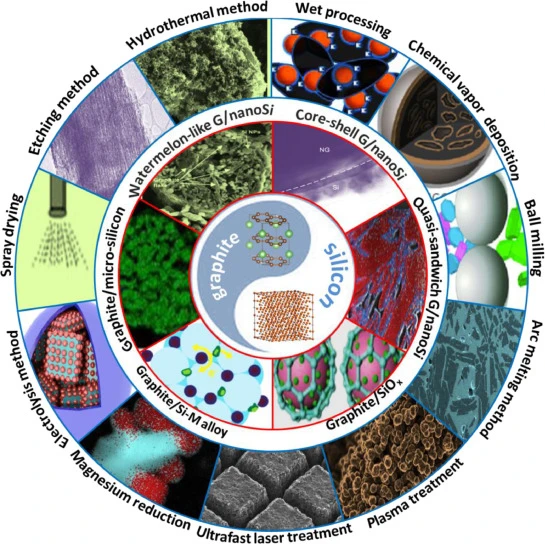
Silicon anode material is hard to classify for a different reason than graphite. Graphite fights the classifier because its particles are flat plates. Silicon fights it because of what happens once the particle is inside the battery, and because the material you actually run is rarely pure silicon. In production it is almost always a silicon-carbon composite, a silicon oxide, or a nano-silicon blend mixed into graphite.
The core problem is volume expansion. Pure silicon swells about 300% when it absorbs lithium; graphite swells about 10%. That expansion cracks the particle and tears the electrode, and capacity dies within a few hundred cycles. The standard fix is to shrink the silicon to the nanoscale and lock it into a carbon or graphite host with a tight particle size distribution. If the D90 runs too high, oversized particles expand and crack locally. If the D90 runs too low, the fine fraction blows up the surface area, burns lithium in the first cycle, and drags down efficiency and tap density.
This article covers why silicon anode is hard to classify, the PSD targets for each material type, and how to set up an air classifier to hold a sharp top cut without damaging the nanoscale silicon.
Why Silicon Anode Is Harder to Classify Than Conventional Anode Materials
The 300% Expansion Problem
For most powders, particle size is about consistency. For silicon anode, it is about performance. A single oversized particle swells and cracks the electrode around it, and that crack becomes a starting point for more damage. To the cell maker, an out-of-spec D90 shows up as early failure and short cycle life.
The fine end matters just as much. Nanoscale silicon has a huge surface area, and all of it reacts with the electrolyte on the first cycle to form the SEI layer, burning lithium permanently. That is why silicon anodes lose first cycle efficiency. Let too many fines through and efficiency drops. Let oversize through and cycle life drops. A silicon line has to hold both ends of the distribution at once.
Three Materials, Three Problems
Pure nano-silicon, with primary particles around 100 to 200 nm, is used as a small additive, usually 2 to 10 percent blended into graphite. The main challenge is agglomeration: nanoparticles clump into soft lumps the airflow reads as single large particles.
Silicon oxide, or SiOx, is a micron scale particle with a D50 around 5 to 10 microns. It expands less, about 150 to 200 percent, and gives moderate capacity. Its consistency depends on a narrow size span, because the oxygen content changes with particle size.
Silicon-carbon composite is nano-silicon embedded in a carbon or graphite matrix, and it is the mainstream commercial anode. It targets a D50 of 8 to 15 microns and gives 400 to 650 mAh/g with acceptable cycle life. The classifier has to deliver a sharp top cut and even silicon dispersion.
Agglomeration and Nanoscale Handling
Silicon at the nanoscale is strongly cohesive. A soft aggregate is read by the airflow as one large particle and pushed to the coarse stream, or it survives as an oversized lump that behaves like a coarse particle in the electrode. The classifier has to break these lumps apart and reject genuine oversize at once, with enough energy to disperse but not so much that it crushes the primary particles. A general purpose mineral classifier will underperform here.
PSD Specs by Anode Type
Anode type D50 target D90 target Key requirement
Nano-silicon additive 0.1 to 0.2 microns below 0.5 Preserve primary particle
Silicon oxide (SiOx) 5 to 10 microns 15 to 20 Narrow span
Silicon-carbon composite 8 to 15 microns 25 to 35 Sharp top cut
Silicon-graphite blend 6 to 12 microns 18 to 25 Matched to graphite size
Specs vary by cell maker and electrode design. Check the buyer’s incoming inspection before setting parameters.
As with graphite, the D90 is the harder limit. D50 is set by rotor speed and moves predictably. D90 is the tail, the particles just above the cut point that slip through on turbulence or feed variation. For silicon, an oversize tail means particles that will expand and crack the electrode.
Configuring a Classifier for Silicon Anode Powder
Set the Cut Point for the Top Cut, Not the Median
Most classifiers are commissioned around D50 because it is easy to measure. For silicon anode, commission against the D90 first. Set the rotor speed to hold the D90 limit, then measure the resulting D50 and check the fines. A practical start is to run the rotor 10 to 20 percent faster than a spherical mineral calculation would suggest for your D90 target, then measure the real PSD by laser diffraction and step the speed back until the D90 sits on spec.
Run Airflow Low to Protect the Nanoparticles
Higher airflow increases drag and pulls more material into the fine stream. On silicon it drags fine high surface area particles through the cut point and inflates the fines fraction, which hurts efficiency. It also hits loosely bonded composites harder, which can crack the carbon host. Keep airflow at the minimum needed for stable transport, about 10 to 20 percent below what a mineral would use.
Keep the Feed Stable and Pre-Dispersed
When feed spikes, the particle concentration in the zone rises and the cut point shifts coarser. Run the feed at 60 to 75 percent of rated capacity and hold it within plus or minus 5 percent with a mass flow controller. For nano-silicon or an agglomerating feedstock, add a dispersion stage right before the classifier.
Ferrous-Free Is Not Optional
A few parts per million of iron can short a cell. A conventional carbon steel classifier sheds iron from rotor wear. Silicon anode lines need ceramic coated rotors and liners, and the product path should meet the cell maker’s ferrous spec. For fine or pyrophoric grades, an inert gas loop also prevents oxidation and dust explosion.
Starting points
Rotor speed: 10 to 20 percent above the spherical material calculation for the same D90, commissioned against D90 first.
Airflow: 10 to 20 percent below mineral capacity, minimum for stable transport.
Feed: 60 to 75 percent of capacity, within plus or minus 5 percent, pre-dispersed if agglomerating.
Contamination: ceramic coated rotor and liner, inert gas for fine or pyrophoric grades.
Verification: sample every 30 minutes for the first 4 hours of a new grade.
Production cases
Case 1: Silicon-Carbon Composite D90 Cut from 43 to 29 Microns
A producer supplied a cell maker with a 35 micron D90 limit. About one batch in five failed incoming QC at 41 to 45 microns. The classifier had been commissioned on mineral settings and checked only against D50, which was fine at 11.2 microns. The oversized fraction slipped through because the D90 tail was never the target. The cell maker traced early capacity fade back to cracking around those oversized particles.
Case 2: SiOx Grade Narrowed Span and Cut First-Cycle Loss
A SiOx producer ran a grade targeting D50 7 and D90 18 microns, but the D10 had crept below 1 micron, inflating surface area and dragging first cycle efficiency below the buyer’s floor. The cause was excess airflow pulling fine oxide through the cut point, plus a steel rotor shedding trace iron.
Airflow was cut 18 percent, rotor speed trimmed to hold the top cut, and the steel rotor and liner replaced with ceramic coated parts, with an inert gas loop for the fine oxide. Span narrowed 28 percent, D10 recovered to 1.6 microns, first cycle efficiency improved 2.1 points, and trace iron dropped below the 5 ppm threshold.
Classifying Silicon Anode Or Another Battery Material?
EPIC Powder Machinery configures air classifiers for battery material work, including sharp top cuts, nanoparticle and composite handling, contamination control, and inert gas protection. We run free classification trials on your silicon, SiOx or silicon-carbon feed and return full PSD data before you commit. Send your feed PSD, target D50 and D90, and throughput.
Request a Free Classification Trial: www.powder-air-classifier.com/contact
Explore Our Air Classifier Range: www.powder-air-classifier.com
Frequently Asked Questions
What D50/D90 should I use for a silicon-carbon anode?
For a mainstream composite, D50 is usually 8 to 15 microns with D90 at 25 to 35 and D99 inside 35 to 45. The exact band depends on the cell format and silicon loading. Higher silicon content tightens the top cut because oversized particles expand and crack. Set the D90 against the buyer’s inspection first, then tune the median.
Why does nano-silicon agglomerate during classification and how do I stop it?
Nano-silicon is strongly cohesive. Forces that are negligible at micron scale dominate at the nanoscale, so primary particles clump into soft lumps the airflow reads as coarse particles. Fix it with a dispersion stage ahead of the classifier, reduced airflow, and humidity control on the process air. Grounding and, for fine grades, an inert gas loop also help.
Can one classifier handle silicon, SiOx and silicon-carbon composite?
Not with one set of parameters. The three materials separate in different size ranges, fail differently, and have different contamination and gas requirements. One platform can switch between them, but each material needs its own recipe for rotor speed, airflow, feed rate, dispersion, and gas setting.
Epic Powder

“Thanks for reading. I hope my article helps. Please leave a comment down below. You may also contact EPIC Powder online customer representative Zelda for any further inquiries.”
— Jason Wang, Engineer