1. Battery Materials Need More Than Just Fine
Particle size control for battery materials goes far beyond meeting a D50 target. Cathode materials, anode materials, conductive additives, and solid electrolytes each have their own particle size window, and every one of these requirements maps directly to electrochemical performance.
For lithium iron phosphate (LFP), for example, studies show that mixing large and small particles at a 3:1 ratio delivers a discharge capacity of 159.4 mAh/g, significantly better than a single particle size distribution. This means a classifier must not only cut accurately, but also cut intelligently, adjusting the cut point and the shape of the size distribution to suit the material system. Research on NMC cathode materials likewise shows that large particles crack more easily during cycling, accelerating capacity fade. Controlling the coarse particle upper limit (D97 or D90) is therefore directly tied to cycle life.
This is the core challenge of battery material classification: achieving fine powder cut precision, strictly controlling coarse particle leakage, and maintaining batch-to-batch consistency at the same time. The turbo air classifier and the multi-rotor air classifier are two different technical routes designed to meet this challenge.
2. How the Two Classifiers Work
2.1 Turbo Air Classifier: Single Rotor
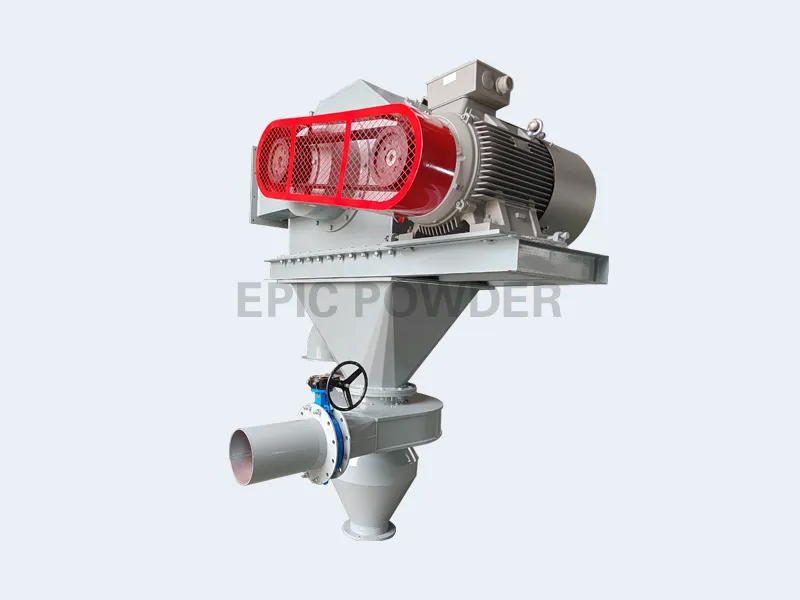
The turbo air classifier uses a single-rotor structure. Material is carried by airflow into the classification zone, where the high-speed rotor generates a centrifugal field. Fine particles pass through the rotor blade gaps into the collection system, while coarse particles are thrown outward against the wall, then fall back to the milling zone or are discharged.
The strengths of this design are its simple structure, intuitive operating parameters, and controllable maintenance cost. For materials with moderate fineness requirements and conventional density and morphology, such as calcium carbonate, quartz, and ordinary ceramic powders, the turbo classifier delivers classification at a favorable cost-performance ratio. Its limitation is equally clear: the entire classification zone relies on a single rotor to generate the centrifugal field, so the match between the airflow field and the centrifugal field is limited. When the material has low bulk density, irregular morphology, or is being scaled up in output, the risk of coarse particle leakage rises significantly.
2.2 Multi-Rotor Air Classifier: Multi-Stage Classification
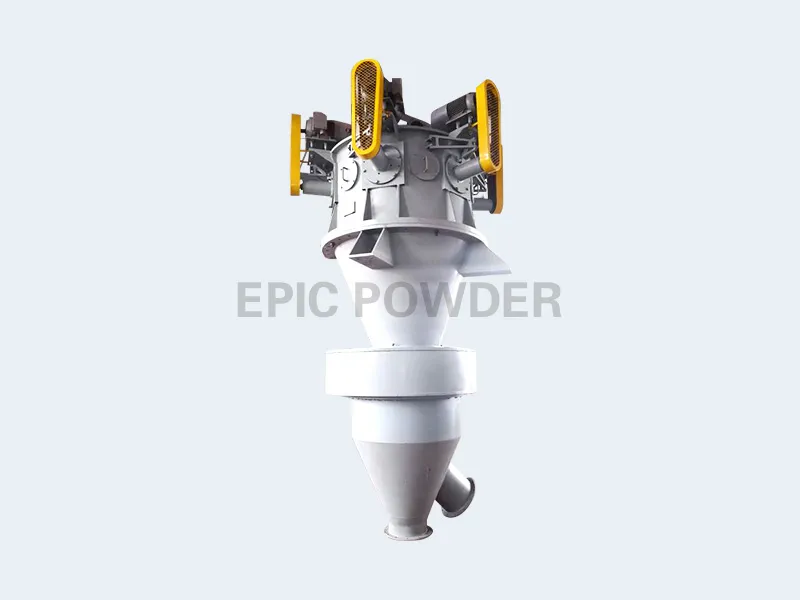
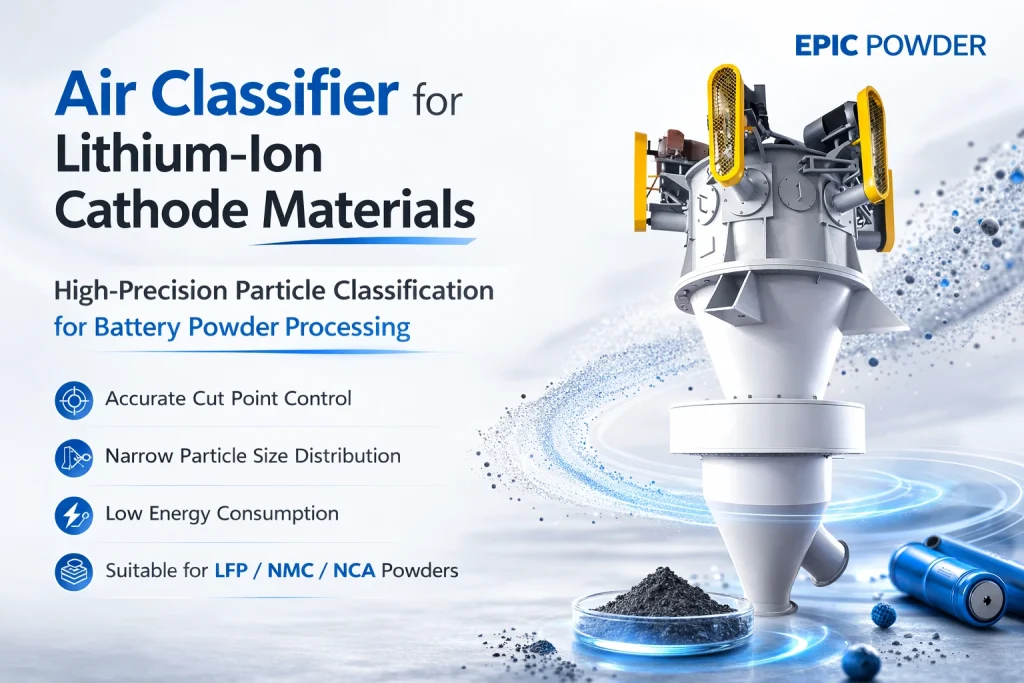
The multi-rotor air classifier (such as the HTS series) takes a completely different approach. Rather than relying on a single rotor to handle everything, it breaks the process into multiple stages: self-diverting inertial pre-classification combined with turbo secondary precision classification. In practice, the HTS stacks 2 to 6 classification rotors vertically, with rotor diameters from 315 to 630 mm, to form a multi-stage, series classification path.
The core difference is a stronger, more uniform centrifugal field, with each stage given a clear task. Pre-classification first removes most coarse particles, reducing the load on the downstream precision stage; secondary classification then focuses on precise cutting of the fine powder window, minimizing coarse particle leakage.
A test run on spherical resin porous carbon shows this difference in practice. The material has a bulk density typically below 0.3 g/cm³ and high porosity, which makes it prone to misclassification in a single-rotor classifier where aerodynamic drag dominates. In the HTS test, the raw material measured D50 ≈ 7.8 µm, D90 ≈ 18.5 µm, D97 ≈ 21 µm, and span 0.68. After classification, samples collected from two cyclone stages held D50 at 7.1–7.3 µm and cut D97 down to 16.5–17.8 µm, with span falling to 0.48–0.51. All measurements were made with a laser diffraction analyzer using ultrasonic dispersion.
| Parameter | Raw material | Classified product |
| D50 | ≈ 7.8 µm | 7.1–7.3 µm |
| D97 | ≈ 21 µm | 16.5–17.8 µm |
| Span (D90−D10)/D50 | 0.68 | 0.48–0.51 |
The result meets the common battery-grade acceptance window of D50 7 ± 1 µm, D97 below 20 µm, and span below 0.55.
3. Head to Head: How the Two Designs Perform on Battery Materials
3.1 Cut Precision and Coarse Particle Upper Limit (D97)
The single-rotor turbo classifier performs steadily on materials with conventional density and good flowability, and its D97 control satisfies most industrial scenarios. However, when output is scaled up or material density deviates from the design condition, the risk of coarse particle leakage rises, and batch-to-batch D97 variation may exceed what battery materials can tolerate.
The multi-stage path of the multi-rotor classifier is effectively a series of checkpoints placed before coarse particles can leak through. Each rotor stage screens at its own cut point, so a coarse particle must break through several centrifugal fields in succession to reach the fine product. In the porous carbon test above, D97 dropped from roughly 21 µm to 16.5–17.8 µm in a single pass. For battery-grade materials that require a stable D97/D50 ratio within the target window, this multi-rotor advantage is more pronounced.
3.2 Handling Low-Density and Morphology-Sensitive Materials
Low-density materials, including porous carbon, silicon-carbon anode materials, and some organic powders, face a fundamental problem in single-rotor classifiers: particles are light, centrifugal force is insufficient, and aerodynamic drag dominates their trajectory, so coarse particles that should be separated end up in the fine product.
The multi-rotor design responds by using the pre-classification stage to separate most coarse particles through inertia differences, reducing the coarse fraction entering the precision zone. The secondary stage then focuses on the fine powder window. Even with low particle density, the stacked multi-stage centrifugal field provides enough separation driving force. This division of labor reduces sensitivity to the density of any single particle, making the classification window for low-density materials more controllable.
3.3 Contamination Control and Inert Atmosphere Operation
Battery-grade materials tolerate extremely low metal contamination, typically requiring iron and other metal impurities below 10 ppm. Both classifier types can be fitted with contact surfaces lined with alumina ceramic or polyurethane, which eliminates metal-to-powder contact. The multi-rotor design adds a structural advantage in wear management: pre-classification reduces the direct impact of hard particles on the precision zone, so rotor blade wear is slower and long-term contamination risk is lower.
In addition, the multi-rotor classifier is easier to configure with zoned nitrogen circulation and explosion-proof design, which is especially important for oxygen- and moisture-sensitive materials such as silicon-carbon anodes. Its classification efficiency (extraction ratio) can reach 90%, minimizing waste on high-value battery materials.
4. A Practical Decision Framework for Equipment Selection
Step 1: Define your critical quality attributes. Is D50 control the priority, or are the D97 upper limit and span value the acceptance bottleneck? If customer complaints center on “oversized coarse particles” or “batch-to-batch distribution drift”, evaluate the multi-rotor solution first.
Step 2: Audit your material. Does its bulk density, morphology (spherical / irregular / porous), or hardness challenge a single-rotor centrifugal field? If the bulk density is below 0.5 g/cm³ or the morphology is highly irregular, the risk of a single-rotor solution rises significantly.
Step 3: Assess scale-up risk. Do you need to keep D97 variation within ±1.5% from lab to mass production? If so, the multi-stage logic of the multi-rotor classifier is better at maintaining cut point stability during scale-up.
Step 4: Confirm contamination and safety requirements. Do you need nitrogen circulation, explosion-proof design, and all-ceramic contact surfaces? The multi-rotor design offers more flexibility in zoned inert protection and wear management.
Step 5: Test before you commit. Run comparative classification trials on your actual material and verify span value and batch consistency. Any qualified equipment supplier should be willing to produce reproducible data on your material before you place an order.
5. Choosing the Right Option for Your Battery Line
The turbo and multi-rotor classifiers are not a case of one replacing the other. They are two tools for different material difficulties and different quality requirements.
The single-rotor turbo classifier suits materials that are easy to classify and applications that prioritize cost-effectiveness and simple operation: conventional mineral fillers, chemical powders with moderate fineness requirements, and applications with relatively loose D97 limits.
The multi-rotor classifier suits materials that are difficult to classify and applications where consistency is a core competitive barrier: silicon-carbon anodes, porous carbon, cathode materials with strict D97 upper limits, and battery-grade powders that require inert atmosphere protection.
If your material is a silicon-carbon anode or porous carbon, or if you have a strict D97 upper limit requirement, the multi-rotor solution is worth prioritizing. Epic Powder’s HTS series multi-rotor air classifier is designed precisely for the classification needs of these high-difficulty battery materials.
Epic Powder
Epic Powder specializes in the R&D and manufacturing of air classifiers and milling-classification systems, with extensive engineering experience in battery materials, mineral processing, and chemical powders. For material classification trials or selection consulting, please contact us.

“Thanks for reading. I hope my article helps. Please leave a comment down below. You may also contact EPIC Powder online customer representative Zelda for any further inquiries.”
— Jason Wang, Engineer