Why Calcium Oxide Costs More Than People Expect
Calcium oxide is abrasive, hygroscopic, and reactive. Those three words matter because they define what the classifier has to fight through. When the target is D97=8μm, you are asking the machine to separate a small stream of fines from a much larger stream of coarse material. The energy cost adds up fast. The budget pain usually shows up in two places. Electricity covers the fan, the classifier rotor, the dust collector, and the compressed air. Labor covers sampling, damper adjustments, cleaning cycles, and reworking off spec batches. Either one can eat the margin if it is not controlled.
The Hidden Drains in Older Classification Setups
Many plants still run cyclones, bag filters, or classifier designs that were common twenty years ago. But they carry operating costs that do not always show up on the capital quote.
The first drain is pressure drop. Older separators usually need longer ducts and higher fan pressure to move the required air. Every extra kilopascal converts straight into kilowatt hours. I have stood next to classifier fans that were among the largest motor loads in the entire plant. The second drain is cut point drift. Without tight rotor speed and airflow control, the product wanders above and below 8μm. Off spec material goes back to the mill, and the mill has to grind it again. That is energy and capacity lost twice. The third drain is labor. In a continuous operation, someone has to sample, read the result, and adjust dampers or fan speed every shift. That is one operator tied to the classifier. The fourth drain is buildup. Calcium oxide sticks to internal surfaces. More buildup means more cleaning stops, more wear parts, and less actual production time.
What Changes With an HTS Air Classifier

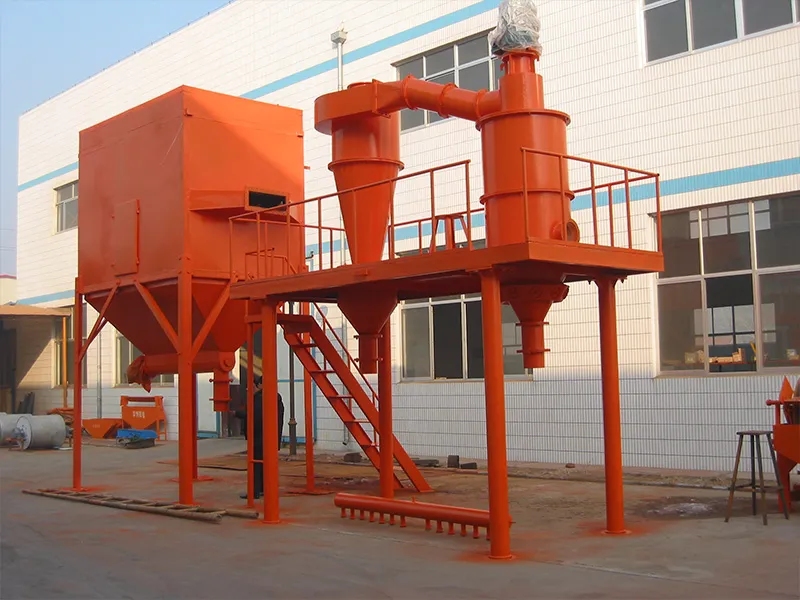
HTS classifiers are built around the physics of fine particle separation, not around making an old design cheaper. In the field, I see three things change on calcium oxide lines.
First, the fan works less. The rotor and guide vanes create a compact classification zone with shorter internal paths and better blade geometry. The pressure difference across the fan drops. On most calcium oxide jobs, this alone is the biggest energy saving.
Second, the cut point holds. Variable rotor speed and regulated airflow keep the separation near 8μm. Less off spec material is recycled, so the upstream mill and classifier work less per finished tonne.
Third, the operator steps back. Once the set point is locked, the machine holds it. The operator moves from constant adjustment to monitoring. That labor can be redeployed to other parts of the plant.
A Practical ROI Example
Important: These numbers are an example only. Replace them with your actual throughput, electricity rate, labor cost, and measured or quoted power figures before using them for a decision.
Take a calcium oxide line producing 2 tonnes per hour, running 6,000 hours per year, with a target of D97=8μm. Before HTS, the specific power is 85 kWh per tonne and the classifier needs two operators per shift. After HTS, the specific power drops to 62 kWh per tonne and one operator per shift is enough.
Assumptions
| Parameter | Value |
| Annual output | 12,000 t |
| Electricity rate | $0.10 / kWh |
| Operator cost | $8 / hour |
| Power before HTS | 85 kWh / t |
| Power with HTS | 62 kWh / t |
| Operators before HTS | 2 per shift |
| Operators with HTS | 1 per shift |
Electricity savings
(85 – 62) kWh/t × 12,000 t × $0.10/kWh = $27,600 / year
Labor savings
1 operator × 8 h/shift × 3 shifts × 330 days × $8/h = $63,360 / year
Total estimated annual savings
| Cost line | Annual savings |
| Electricity | $27,600 |
| Labor | $63,360 |
| Total | $90,960 |
If the HTS package and installation cost $180,000, the simple payback from electricity and labor alone is about 24 months. Add better yield, less reprocessing, and lower maintenance, and the number gets shorter.
How to Run the Numbers Yourself
Do not use my example for your business case. It is only there to show the shape of the calculation. Start by measuring your current specific power. Log kWh and tonnes over a typical week, then divide to get kWh per tonne. Next, count the operator hours per shift that go into sampling, adjusting, and cleaning the classifier.
Then ask your supplier for an HTS power estimate at your target D97 and throughput. Estimate how many of those operator hours can be moved elsewhere once the machine is holding the cut point automatically. Finally, add the secondary gains. Better yield, less reprocessing, longer runs between cleanouts, and lower wear parts all improve the payback.
Payback (years) = Total investment / (annual electricity savings + annual labor savings + annual secondary savings)
What to Ask Before You Buy
I always tell buyers to ask the same five questions.
1. What D97 cut point can you guarantee at my design throughput?
2. What pressure drop should I expect?
3. How is the cut point controlled automatically?
4. Which parts touch the calcium oxide, and how long do they last?
5. And can you show reference data from a similar calcium oxide or mineral application?
The answers tell you whether the supplier understands your material, not just their machine.
Who This Fits Best
This pays off fastest for producers of calcium oxide, calcium hydroxide, limestone filler, and other fine mineral powders below 10μm D97. If your line runs more than 4,000 hours per year and power or shift labor is eating your margin, the HTS case is usually strong.
Get a Tailored ROI Estimate
Send us your throughput, target D97, current power draw, and labor layout. We will size an HTS air classifier.
Request a Project Assessment
Epic Powder
At Epic Powder, we offer a wide range of equipment models and tailor solutions to meet your specific needs. Our team has more than 20 years experience in various powders processing. Epic Powder is specialized in fine powder processing technology for mineral industry, chemical industry, food industry, pharama industry, etc.
Contact us today for a free consultation and customized solutions!

“Thanks for reading. I hope my article helps. Please leave a comment down below. You may also contact EPIC Powder online customer representative Zelda for any further inquiries.”
— Jason Wang, Engineer