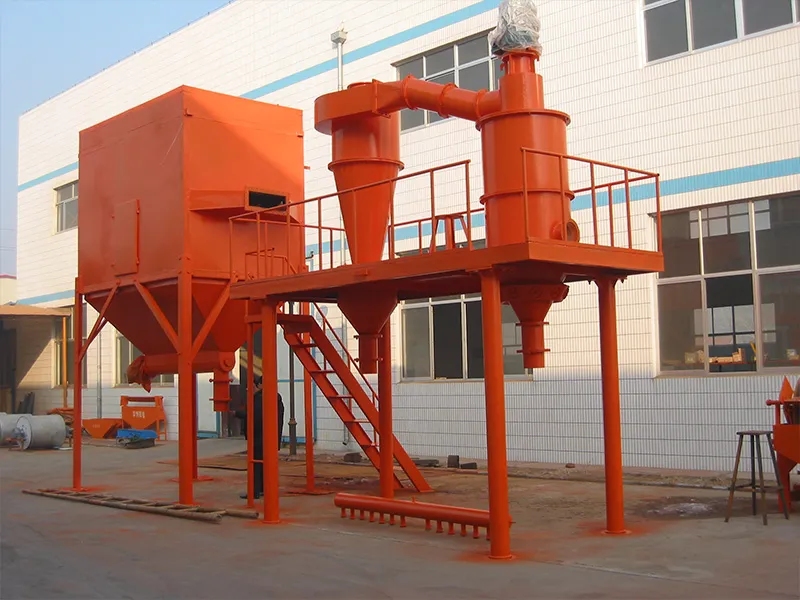
Ground calcium carbonate (GCC) plants reach the same decision over and over. The mill runs, but the classifier no longer holds a sharp cut. Energy bills climb. A customer asks for a finer grade and the current line cannot deliver it. At that point the owner compares two paths: upgrade the classifier, or replace the whole milling and classification line. Cost, energy, throughput, and downtime decide which path wins.
What a classifier retrofit changes
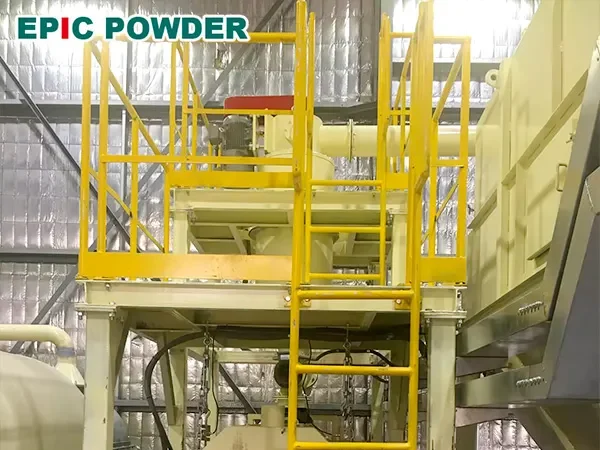
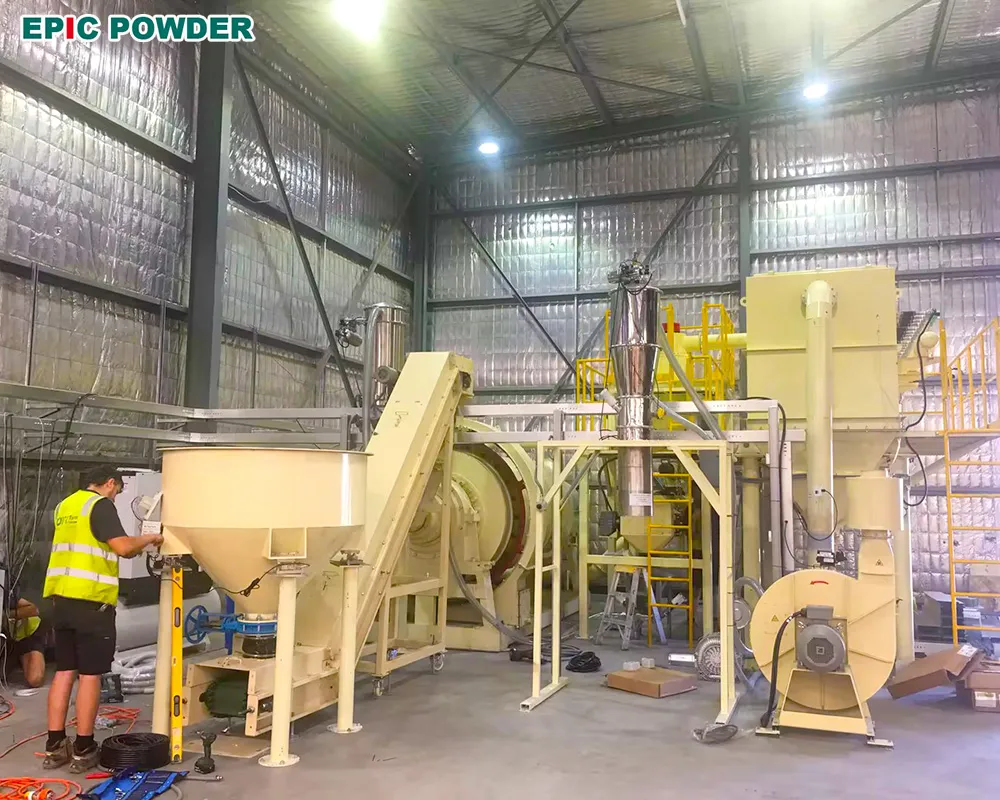
A retrofit replaces the separator inside an existing line. The mill, feeder, conveying equipment, and dust collection stay in place. The new classifier accepts the same feed and returns coarse material to the same mill.
The classifier sets the cut point. A worn or dated separator lets fine finished powder fall back into the mill. The mill then re-grinds product that already meets specification, and that rework burns electricity for no added value. A retrofit installs a classifier with a sharper cut, so less finished powder returns to the mill and more motor power goes into new feed.
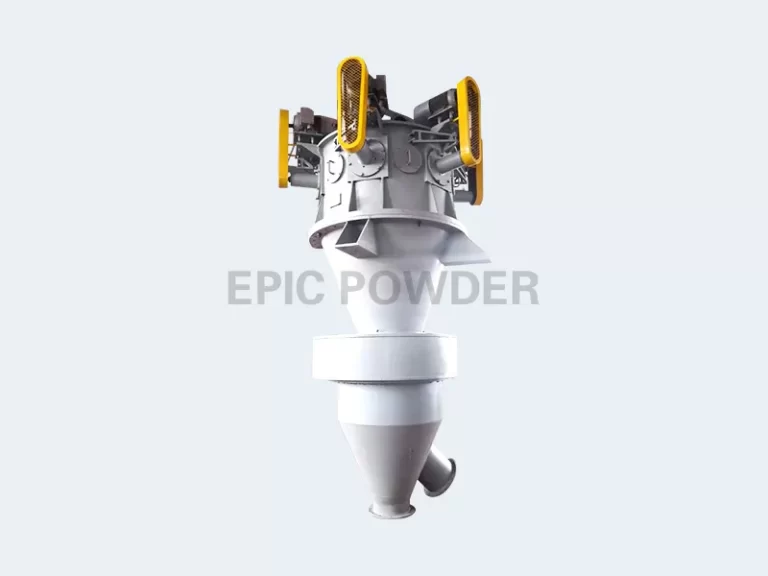
EPIC Powder Machinery builds two classifier families for exactly this job. The ITC series is a vertical single-rotor classifier with a cut range of D97 5 to 200 µm. The HTS series uses a horizontal rotor and covers ultrafine classification at D97 3 to 45 µm. Both mount onto existing closed-circuit grinding systems and replace an old separator without new civil work or foundation changes.
What a full line replacement changes
A full line replacement removes the mill, the classifier, and often the feed and collection equipment. Installation starts from an empty pad.
This path resets wear across the entire route. Mill liners, classifier blades, fan impellers, and piping all begin new. The project also opens the door to a larger mill, a multi-rotor classifier, or a different grinding technology that the current building cannot hold.
Why the classifier controls the whole line’s energy bill
A full line replacement removes the mill, the classifier, and often the feed and collection equipment. Installation starts from an empty pad.
This path resets wear across the entire route. Mill liners, classifier blades, fan impellers, and piping all begin new. The project also opens the door to a larger mill, a multi-rotor classifier, or a different grinding technology that the current building cannot hold.
Why the classifier controls the whole line’s energy bill
A full line replacement removes the mill, the classifier, and often the feed and collection equipment. Installation starts from an empty pad.
This path resets wear across the entire route. Mill liners, classifier blades, fan impellers, and piping all begin new. The project also opens the door to a larger mill, a multi-rotor classifier, or a different grinding technology that the current building cannot hold.
Why the classifier controls the whole line’s energy bill
Calcium carbonate grinding is an energy-intensive step. Ultra-fine GCC can draw 80 kWh per tonne or more, and the number rises fast as the target size drops. Electricity is the single largest operating cost on most fine GCC lines.
Much of that energy gets wasted when the classifier is weak. Every tonne of on-size powder that returns to the mill must be separated again, which costs air, fan power, and mill motor hours. A classifier with the right cut and a low pressure drop removes that rework. This is the reason a classifier change often moves the energy needle more than a new mill ever could on its own, because the mill in a closed circuit spends most of its effort responding to what the classifier sends back.
The cost gap
A retrofit costs a fraction of a full line. The classifier and its installation typically run 10 to 20 percent of the price of a complete mill-and-classifier line at the same output. Downtime stays short. Most classifier swaps finish in two to three days.
A full line replacement carries a larger price and a longer stop. Foundation work, mill erection, and electrical and piping changes add weeks on top of the equipment cost. The plant also loses the output it would have produced during that window, and lost output is real money on a line that sells every tonne it makes.
Energy and throughput: a worked example
Consider a finishing line that produces D97 10 µm calcium carbonate at 4 tonnes per hour. The line runs 7,000 hours a year, so it makes 28,000 tonnes. Electricity costs US$0.10 per kWh.
Before the retrofit the line draws 80 kWh per tonne. The annual total is 2,240,000 kWh, or US$224,000 in power.
A retrofit with a high-efficiency HTS classifier cuts specific energy by 16 percent. The line then draws 67.2 kWh per tonne, and annual power falls to US$188,160. The saving is US$35,840 a year.
The same new classifier often lifts throughput by 15 to 25 percent with a sharper cut and lower pressure drop. When the plant sells that extra output, the payback shortens. At US$0.12 per kWh the energy saving on the same line rises to about US$43,000 a year. Assume the retrofit costs US$55,000 including installation. Energy savings alone repay the spend in about 18 months at US$0.10 per kWh. Higher local rates shorten that. The throughput gain shortens it further wherever the plant can sell the extra tonnes. Industry data for classifier upgrades puts the typical payback between 6 and 12 months, because most retrofit cases combine energy savings with additional sold output.
When a retrofit pays off
A retrofit wins when the mill itself still has years of life and already holds the fineness the market needs. The real problems sit in the classifier: high energy use, a soft cut, too much oversize returning to the mill, or a top size the current separator cannot hold tight enough. Replacing the classifier fixes these at low cost with minimal lost time.
Retrofits also win when the plant needs a finer cut than the current separator can hold while the mill can still feed it. A run that moves from D97 20 µm down to D97 10 µm may need only a higher-speed classifier, not a new mill.
When a full line replacement wins
A full line replacement wins when the mill is the constraint. Worn mill liners, exhausted grinding media, a mill body near the end of its service life, or a throughput ceiling far below demand all point the same way. A new classifier cannot fix a mill that cannot feed it.
A replacement also wins when the plant must reach a much finer product or a much larger volume that the current frame cannot touch. New capacity, a bigger multi-rotor classifier, or a different grinding method needs a new line, not a bolt-on part.
Three checks that separate the two cases
Three measurements settle most decisions.
First, find where the line loses. Compare the product cut against the classifier’s stated range and inspect the mill’s condition. If the classifier cannot hold the target cut while the mill runs fine, retrofit.
Second, price the energy. Read the specific energy in kWh per tonne and multiply by the local rate. The arithmetic in the worked example above applies directly to a plant’s own figures.
Third, test whether the plant can sell more output. Throughput gains only create payback when extra tonnes carry margin. A plant that is demand-limited gets less value from a bigger throughput than one that sells every extra tonne.
EPIC Powder Machinery runs trial classification on customer samples before any equipment is specified. This step shows whether the existing mill plus a new ITC or HTS classifier reaches the target cut, which is the exact information that separates retrofit from replacement.
The ITC and HTS air classifiers
The ITC series is a vertical single-rotor air classifier. Its eleven models span classifier motors from 4 kW to 110 kW and air volumes from 1,200 to 150,000 m³/h. The particle size range covers D97 5 to 200 µm, and classification efficiency reaches 60 to 90 percent. The vertical rotor handles calcium carbonate, kaolin, talc, quartz, and mica, and installs directly into closed-circuit systems with ball mills and roller mills.
The HTS series uses a horizontal classifying rotor for ultrafine classification at D97 3 to 45 µm. It comes in single-rotor models from size 70 to 1000 and multi-rotor modules from 200/4 to 630/6. Classification efficiency runs 60 to 80 percent. The multi-rotor versions raise output for high-volume GCC lines.
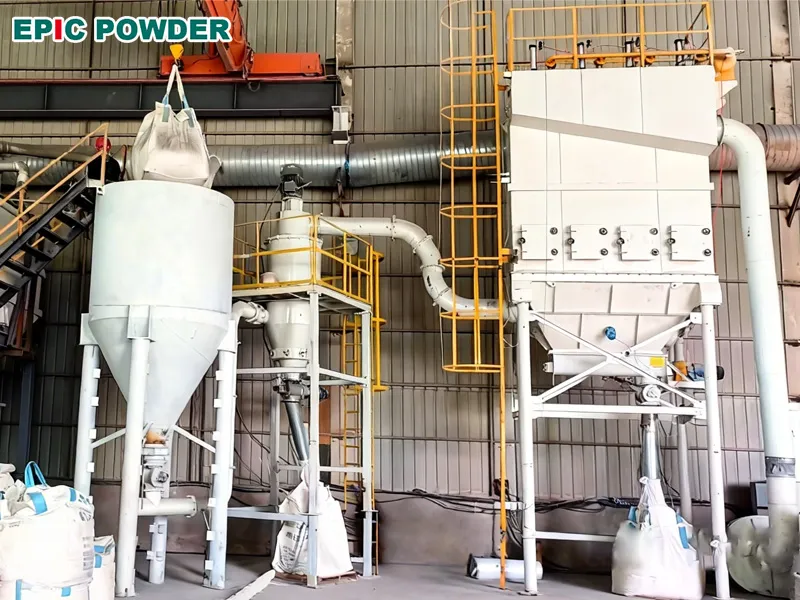
Both series form a complete closed system with a cyclone, dust collector, and induced draft fan, and both retrofit onto existing mill circuits. The rotor speed adjusts through a frequency inverter, so a single classifier can move between cut points as the product mix shifts.
For a calcium carbonate plant whose mill still holds up, a classifier retrofit returns its cost in under two years and often under one, at a small fraction of the price of a new line. The full line replacement earns its place only where the mill itself limits output, fineness, or service life.
Epic Powder
Epic Powder designs grinding and classifying systems for minerals, chemicals, food, and pharmaceuticals. With more than 20 years of powder processing experience, we match the right mill to your target particle size and capacity. Tell us about your material and we will recommend a tested solution.

“Thanks for reading. I hope my article helps. Please leave a comment down below. You may also contact EPIC Powder online customer representative Zelda for any further inquiries.”
— Emily Chen, Engineer