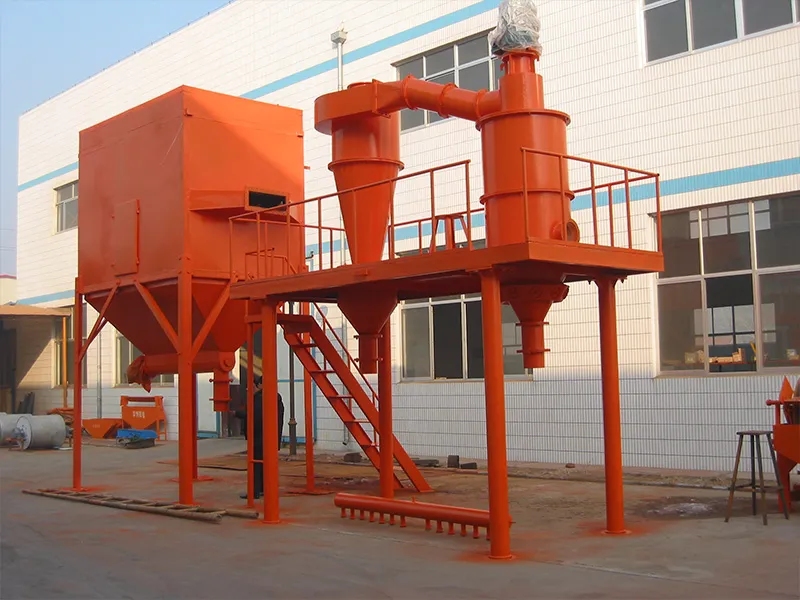
Choosing the right air classifier is one of the most consequential decisions a procurement team can make in a powder processing operation. The wrong equipment means wasted energy, over-grinding, poor cut precision, and costly downtime. This guide explains how air classifiers work, what separates a high-performance turbo classifier from a conventional unit, and what to look for when evaluating powder classification equipment suppliers.
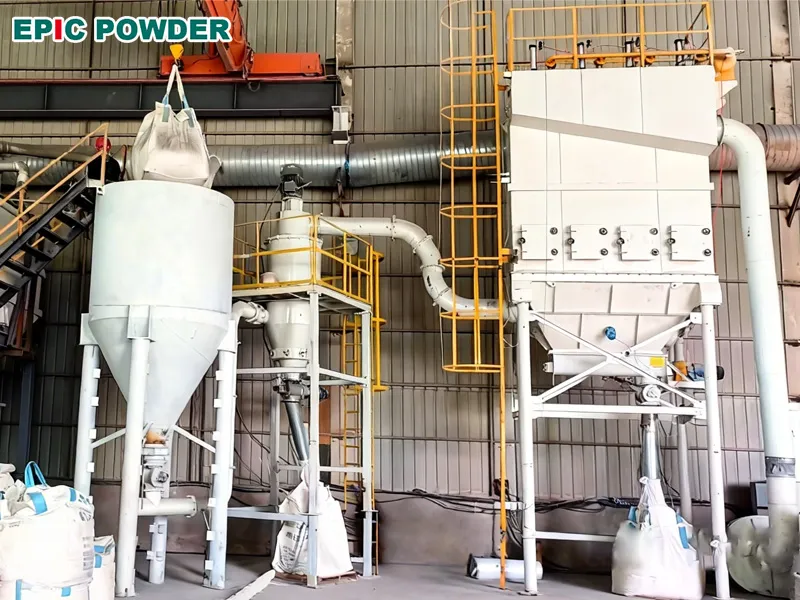
1. What Is an Air Classifier?
An air classifier is a machine that separates fine particles from coarse ones using controlled airflow rather than mechanical screens or sieves. Unlike mesh-based separation, air classification achieves precise, adjustable cut points — making it ideal for ultra-fine powder production in industries such as minerals, chemicals, pharmaceuticals, food, and advanced materials.
Epic Powder designs air classifiers around three classification zones — gravity, free vortex, and forced vortex — that work together in a single unit to deliver consistent, high-purity product fractions.
Key reasons procurement teams specify air classifiers:
- No mesh wear or blinding — unlike screens, there are no consumable filter elements
- Adjustable cut points without mechanical changes — alter airflow or wheel speed
- Handles abrasive, sticky, or difficult-to-disperse materials
- Seamless integration with air-swept mills and spray dryers
- Ultra-fine product range: 1 to 180 microns in a single unit
2. How an Air Classifier Works: The Three Classification Zones
Understanding the working principle helps buyers evaluate competing products with confidence. All three zones operate simultaneously within Epic Powder’s classifier design.
Zone 1 — Gravity Classification (Pre-Separation)
Incoming feed material meets a controlled upward airflow. Large particles (+325 mesh / >44 microns) cannot overcome gravity and fall to a coarse discharge. This pre-separation stage protects the downstream vortex zones, dramatically increasing their efficiency and capacity. For high-volume operations, gravity classification alone can reduce load on the main classifier by 30–50%.
Zone 2 — Free Vortex Classification
Air enters the classification chamber tangentially, creating a natural spinning vortex. Coarse particles are flung outward to the chamber wall and collected; fine particles migrate inward toward the exit. Because the free vortex zone has no moving parts, it is inherently reliable and low-maintenance. Blade angle and airflow volume control the cut point in this zone.
Zone 3 — Forced Vortex Classification (Classifier Wheel)
This is the heart of the system and the primary differentiator between suppliers. A high-speed classifier wheel generates a powerful centrifugal field. Fine particles pass through the wheel blades and exit with the airflow as finished product; coarse particles are rejected outward. Cut size is controlled by two independent variables: airflow rate and wheel rotational speed (RPM). This dual-control approach gives operators precise, repeatable cut points from 2 to 180 microns.
| Classification Zone | Mechanism | Cut Point Control | Moving Parts |
| Gravity | Upward airflow vs. gravity | Airflow volume | None |
| Free Vortex | Tangential airflow spin | Blade angle + airflow | None |
| Forced Vortex | High-speed classifier wheel | Wheel RPM + airflow | Wheel only |
3. Turbo Classifier: What Makes It Different
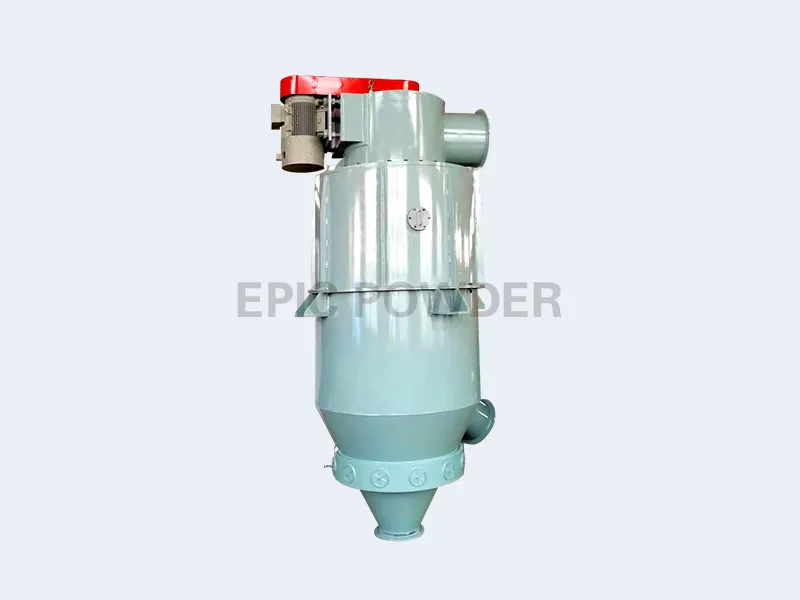
The turbo air classifier represents the highest-performance category of powder classification equipment. Epic Powder’s turbo design uses a horizontal direct-drive wheel — a fundamentally different approach from conventional classifiers that use vertical shafts, belt pulleys, and V-belt drives.
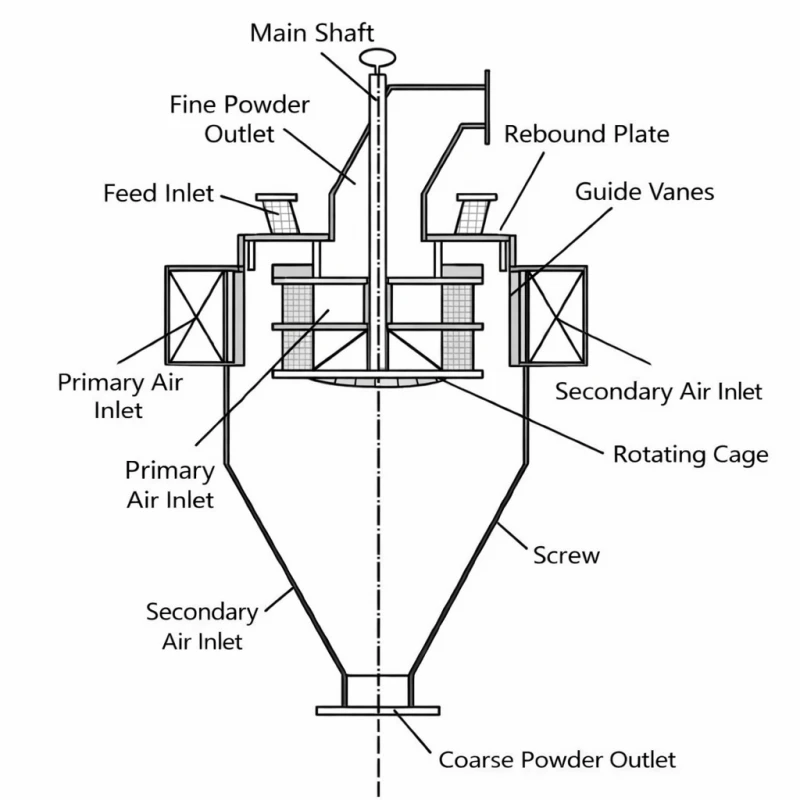
Horizontal Wheel Design: Why It Matters to Buyers
- No belts, no pulleys, no main shaft assembly — fewer failure points, lower spare-parts inventory
- Self-sealing bearings require no lubrication during operation — reducing maintenance labour costs
- Horizontal orientation minimises deposit build-up in ultra-fine product outlets — critical for sticky or cohesive powders
- Direct drive eliminates slip and speed variation — more consistent cut points batch to batch
| Feature | Conventional Classifier | Epic Powder Turbo Classifier |
| Wheel orientation | Vertical | Horizontal (direct drive) |
| Drive system | Belt & pulley | Direct motor drive |
| Bearing lubrication | Required during operation | Self-sealing, no lubrication |
| Spare parts complexity | High (belts, pulleys, shaft) | Low |
| Fine cut precision | Moderate | High — continuous counter-current scrubbing |
| Ultra-fine capability | Limited below 10 microns | Excellent at 3–10 microns |
4. Multi-Wheel Classifier: Scaling Up Without Compromise
A single-wheel classifier hits physical limits at very high throughput with ultra-fine cut points. Epic Powder’s multi-wheel turbo classifier solves this by mounting several identical small-diameter wheels on a shared axis — achieving the capacity of multiple parallel units within a single footprint.
For procurement teams evaluating total cost of ownership, the multi-wheel design delivers:
- One feed point instead of several parallel machines — simplified materials handling
- One common fine product outlet — reduces ducting, fans, and filter area
- One coarse discharge port — simplifies conveyance
- Lower building height and smaller floor area — reduces civil and structural costs
- Consistent cut precision maintained at scale — unlike single small units where fine cuts become harder at high capacity
5. Performance Specifications at a Glance
The following represents typical performance parameters for Epic Powder turbo air classifiers. Exact figures depend on material properties and system configuration — contact Epic Powder’s technical team for application-specific data.
| Parameter | Specification |
| Cut point range | 1 to 180 microns |
| Ultra-fine capability | 2 to 6 microns (multi-wheel) |
| High-yield fine range | 3 to 10 microns |
| Product size distribution | Steep, narrow — no oversize above cut point |
| Material compatibility | Free-flowing, abrasive, sticky, difficult-to-disperse |
| Wear protection | Wear liners available for high-abrasion applications |
| Classifier wheel drive | Direct drive, horizontal orientation |
| Integration | Air-swept mills, spray dryers, standalone |
6. Key Buying Criteria for Procurement Teams
When issuing RFQs or evaluating bids for air classification equipment, consider the following criteria:
Cut Precision and Coarse Cleanliness
The turbo classifier’s counter-current classification air continuously scrubs coarse material — removing entrained fines that conventional designs trap. This is the primary reason turbo classifiers produce cleaner coarse fractions, which is critical when both fractions have commercial value.
Energy Efficiency
Precise cut points mean less over-grinding upstream. Epic Powder classifiers eliminate unnecessary size reduction, directly reducing mill energy consumption. For high-volume operations, this can represent significant annual savings.
Maintenance and Spare Parts
Direct-drive horizontal wheels with self-sealing bearings minimise scheduled maintenance intervals and eliminate belt-change downtime. Request a full bill of wear parts and typical replacement intervals when comparing bids.
Material Compatibility
Verify that the classifier has been tested or is designed for your specific material — particularly if it is abrasive (request wear liner options), cohesive, or has a wide particle size distribution in the feed.
Footprint and Integration
Multi-wheel designs offer a significantly smaller footprint per unit of capacity. If space is constrained or you are replacing multiple parallel classifiers, request a layout comparison.
7. Industries and Applications
Epic Powder air classifiers and turbo classifiers serve a wide range of powder processing industries:
• Minerals and mining — calcium carbonate, talc, feldspar, barite, kaolin
• Chemicals — titanium dioxide, silica, carbon black, specialty chemicals
• Food and agriculture — starch, sugar, plant-based powders, spices
• Pharmaceuticals — active ingredients, excipients, inhalation powders
• Advanced materials — battery materials, ceramics, abrasives, rare earths
• Building materials — fly ash, cement, gypsum, limestone
8. Why Choose Epic Powder?
Epic Powder engineers air classifiers and turbo classifier systems for demanding industrial applications worldwide. Our horizontal direct-drive turbo classifiers deliver unmatched cut-point precision, clean coarse fractions, low maintenance costs, and scalable capacity through multi-wheel configurations — all in a compact, energy-efficient package.
Whether you are specifying a standalone classifier, upgrading an existing grinding circuit, or engineering a complete powder processing line, our technical team will work with you from initial specification through commissioning.

“Thanks for reading. I hope my article helps. Please leave a comment down below. You may also contact EPIC Powder online customer representative Zelda for any further inquiries.”
— Jason Wang, Engineer