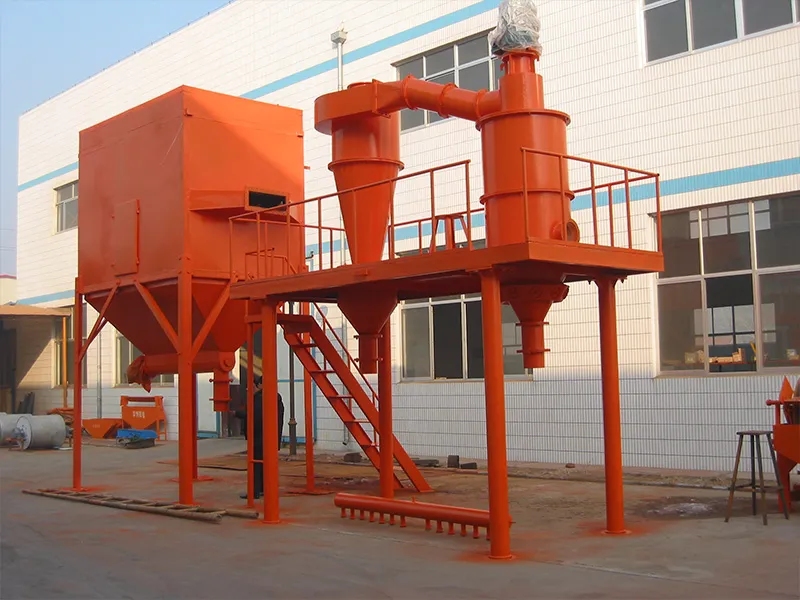
Petroleum coke is a product obtained from the distillation of crude oil, where light and heavy oils are separated, followed by the thermal cracking of the heavy oil. It has an irregular shape, with carbon being its primary elemental component. As a fuel, petroleum coke can replace heavy oil, representing an excellent pathway for new energy applications. It is also used in manufacturing graphite, metallurgy, chemical industries, and more. In this article, you can get to know the critical milling, shaping and classification stages of petroleum coke production.
The world’s largest consumer of petroleum coke is the cement industry, followed by its use in producing prebaked anodes for aluminum smelting or graphite electrodes for steelmaking after calcination. With the booming construction sector, the petroleum coke industry is on a steady upward trajectory, holding promising prospects for the future.
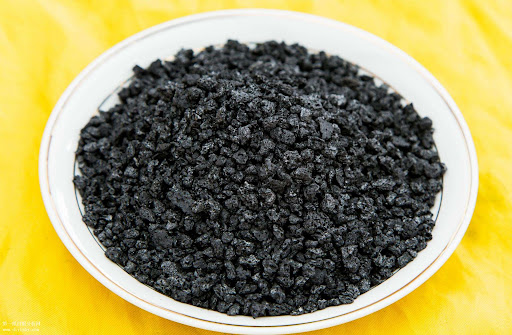
Classification of Petroleum Coke
- Needle Coke: Possesses a distinct needle-like structure and fibrous texture, primarily used for high-power graphite electrodes in steelmaking.
- Sponge Coke: Features high chemical reactivity and low impurity content, mainly used in the aluminum industry and carbon sector.
- Shot Coke (Spherical Coke): Spherical in shape with a diameter of 0.6-30mm, typically produced from high-sulfur, high-asphaltene residual oil. It can only be used as fuel for power generation, cement, and similar industries.
- Fluid Coke: Produced via fluidized coking processes. Its particles are fine (0.1-0.4mm diameter) with high volatile content and thermal expansion coefficient, making it unsuitable for direct use in electrode preparation and the carbon industry.
Production Process and Key Stages
1. Raw Material Receival and Storage
Raw and auxiliary materials mainly include petroleum coke, needle coke, pitch, nitrogen gas, sodium hydroxide, sodium carbonate, and calcium hydroxide. Petroleum coke, needle coke, and pitch are supplied by the client. Nitrogen gas is generated on-site, while sodium hydroxide, sodium carbonate, and calcium hydroxide are purchased locally. Petroleum coke, needle coke, and pitch, packaged in one-ton bags, are transported to Raw Material Warehouses #5, #4, and #7 respectively by truck and unloaded using forklifts.
2. Primary Iron Removal
Petroleum coke and needle coke are transported via forklift from their respective warehouses to the feed hoppers in the drying workshop. After unpacking, they are discharged into the hoppers and fed onto belt conveyors leading to the integrated coarse crushing and drying machine. A magnetic separator installed on the conveyor removes magnetic impurities like bolts and steel fragments.
3. Coarse Crushing
After primary iron removal, the materials are conveyed to the coarse crushing section of the integrated machine. Here, they are crushed to a particle size of approximately 1mm-2mm, then discharged onto a conveyor feeding the drying section.
4. Secondary Iron Removal
A second magnetic separator on the conveyor removes any remaining magnetic impurities from the coarsely crushed material.
5. Drying
The material undergoes drying in the integrated machine’s drying section. Heat is provided by a direct-fired hot air furnace using liquefied natural gas (LNG). The heated air and combustion gases enter the drying chamber at about 200°C for 20-30 minutes. Initial moisture content (Petroleum coke: 8.86%, Needle coke: 13.2%) is reduced to below 5% (approx. 3.7% and 4.9% respectively). The dried material is discharged via a sealed screw conveyor into one-ton bags for temporary storage.
6. Milling
Workshop #2 houses 10 integrated crushing, shaping, and classifying machines for needle coke. Workshop #6 houses 16 such machines for petroleum coke. Dried materials are transported by forklift, hoisted to the machine feed hoppers, unpacked, and fed into the crushing section. Particles are ground to about 0.1mm-0.15mm, then transported via sealed pipeline under vacuum to the shaping section.
7. Shaping
In the shaping section, materials undergo spheroidization processing to form ellipsoidal shapes. This is achieved through the impact between grinding media and grinding between the media and the chamber wall. The shaped material is then conveyed under vacuum to the classifying section.
8. Classification (Primary)
The classifying section consists of a cyclone separator and a bag filter. Material entering this section first goes to the cyclone separator. Particles larger than 0.1mm settle by gravity, are collected periodically, bagged as tailings, and returned to the client. Particles smaller than 0.1mm pass to the bag filter, are collected, bagged as semi-finished product, and transported by forklift: part to Workshop #6 for coating and granulation, part to mixers. Dust-laden exhaust is discharged through stacks.
9. Coating and Granulation
Based on client needs, 10 vertical reactors and 1 horizontal reactor are used. The 10 vertical reactors coat/granulate petroleum coke with pitch, yielding relatively stable quality. The horizontal reactor processes needle coke with pitch, with product quality showing relatively greater fluctuation.
- Vertical Reactor: A vertical cylindrical vessel, energy-intensive but space-efficient, suitable for stable, large-scale batch production. It includes components like the kettle body, cooling jacket, heating system, agitator, motor, and seals. Each batch capacity is 18.576 tons over 4 hours.
Process: The motor drives the agitator. Semi-finished petroleum coke and pitch (ratio 26.191:1) are vacuum-fed into the reactor. Electric heating follows a precise temperature curve (350°C-670°C). Nitrogen is introduced for 2-3 hours to prevent oxidation. The melted pitch coats the coke particles (approx. 0.011mm thick) under agitation for granulation. - Horizontal Reactor: A horizontally placed cylinder, less energy-intensive, suitable for continuous or low-temperature, high-pressure, explosion-proof operations. Capacity is 4.649 tons/hour per batch (4 hours).
Process: Similar to the vertical reactor, semi-finished needle coke and pitch (ratio 26.224:1) are fed. Electric heating follows the same temperature profile. Nitrogen is introduced. Pitch coating thickness is approx. 0.01mm.
10. Cooling
Agitator speed is set to 15 rpm. Cooling water is circulated through the reactor jackets for 1 hour, cooling the material below 50°C. The reactor bottom is opened, and material is discharged via screw conveyor into bags. After sealing, bags are forklifted to the secondary shaping process. A 100kg sample is taken from each batch for testing.
11. Secondary Shaping
Workshop #6 has 3 integrated secondary shaping and classifying machines. Machines #1 & #2 process petroleum coke; #3 processes needle coke. Cooled materials are transported, hoisted, and fed into the secondary shaping section for another spheroidization process, similar to step 7.
12. Secondary Classification
Similar to primary classification, this section uses a cyclone and bag filter. Particles larger than 0.13mm are collected as secondary tailings and returned to the client. Particles smaller than 0.13mm are collected as semi-finished product and sent to mixers. Exhaust is treated and discharged.
13. Mixing
Different batches of semi-finished anode materials (petroleum coke and needle coke) from primary/secondary classification are transported to mixers. They are hoisted, fed into the mixer, and blended to ensure consistent particle size distribution. The mixed material is discharged into bags.
14. Weighing, Packaging, and Shipment
The semi-finished/products are manually weighed and packaged into 600kg bags, stored temporarily in Finished Product Warehouse #3, and later shipped to the client.
15. Performance Testing
- Semi-finished Product Testing: Lab tests include tapped density, particle size (via truth optical analysis), and powder characteristics. Approximately 20% of tested semi-finished product is rejected and returned to the client.
- Final Product Testing: Lab tests include tapped density, particle size, powder characteristics, Malvern analysis, specific surface area, grindability index, and caking index. Approximately 20% of tested final product is rejected and returned to the client.
Based on material balance calculations, the expanded project’s product yield is 62.9% (50,000 / 79,496.958).
Epic Powder
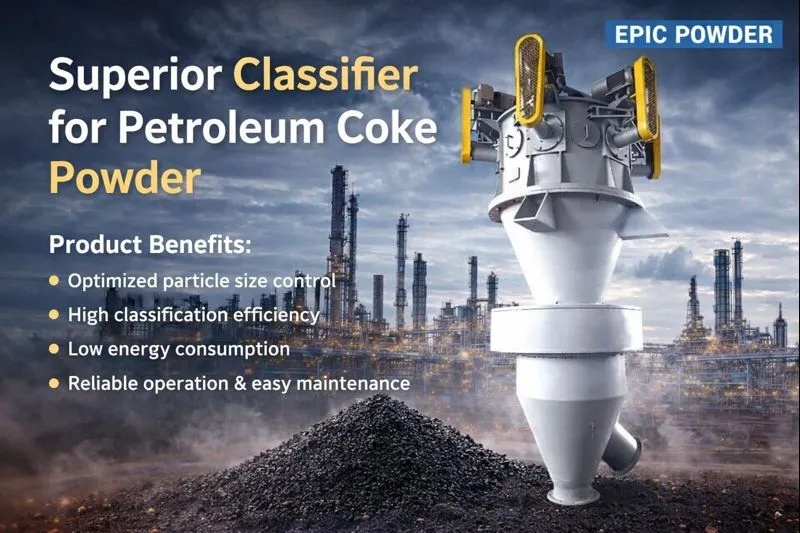
Throughout this detailed process, especially in the critical Milling (6), Shaping (7), Primary Classification (8), Secondary Shaping (11), and Secondary Classification (12) stages, the efficiency and precision of classifying equipment are paramount for achieving consistent particle size distribution, desired spheroidization, and high final product yield.
At Epic Powder, we specialize in advanced classifiers and integrated grinding-classifying systems designed specifically for demanding applications like anode material production. Our technology ensures:
- Precise Cut Points: Achieve sharp, accurate classification at target sizes like 0.1mm, 0.13mm, etc., maximizing yield of in-spec material.
- High Efficiency: Improve overall process efficiency by effectively separating fine product from tailings.
- Consistent Quality: Deliver uniform particle size distribution crucial for downstream coating uniformity and final battery performance.
- Robust Design: Built to handle materials like petroleum and needle coke reliably in continuous production environments.
Whether you are looking to upgrade existing classification steps or design a new production line, Epic Powder’s classifiers can be the key to enhancing your product quality, increasing yield, and boosting profitability.
Contact Epic Powder today to discuss how our classification solutions can benefit your anode material production process.

“Thanks for reading. I hope my article helps. Please leave a comment down below. You may also contact EPIC Powder online customer representative Zelda for any further inquiries.”
— Posted by Emily Chen, Senior Engineer