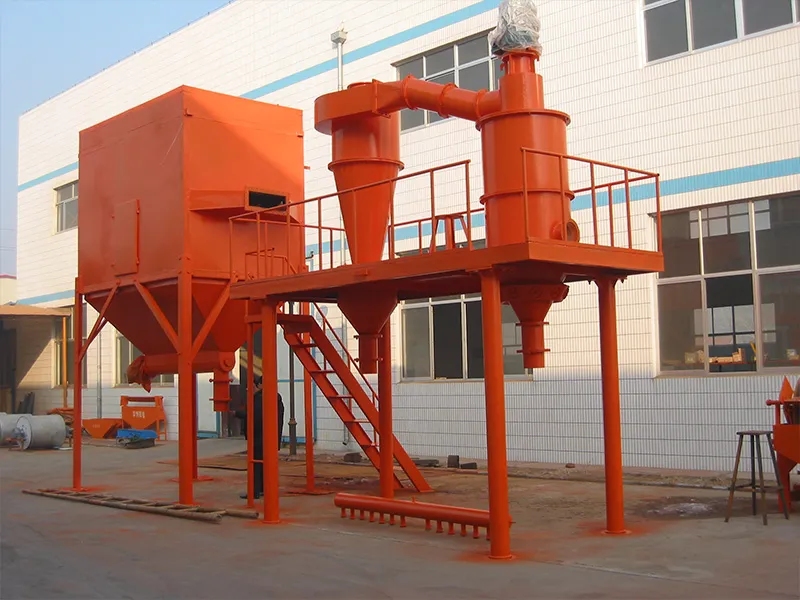
The air classifier is where particle size specification is actually set in a calcium carbonate grinding circuit. For example, the ball mill produces a broad range of sizes. The classifier is what decides which particles become product and which return to the mill. A classifier with poor separation sharpness produces a broad particle size distribution regardless of how long you run the mill. A classifier with a sharp, well-controlled cut point produces the narrow distribution that paint, plastics, and paper markets require.
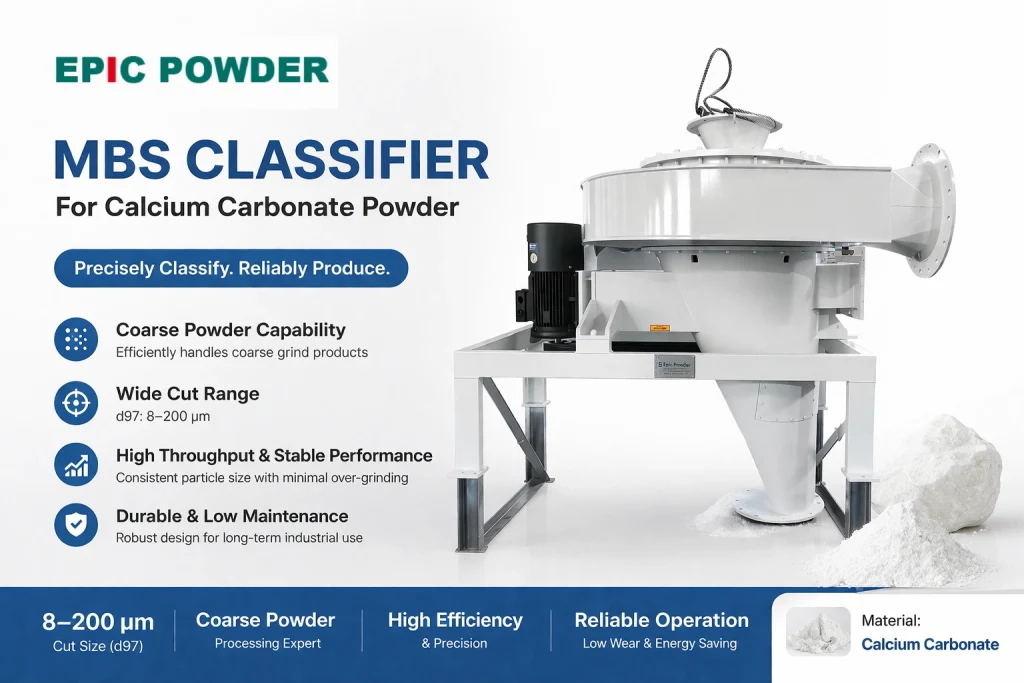
The MBS Series air classifier was designed specifically for dry classification of calcium carbonate and other industrial minerals. It covers D97 from 8 microns to 200 microns. Its hierarchical internal structure reduces pressure drop compared to conventional classifier designs. This can directly lowers the fan energy cost that typically accounts for 15-25% of total classifier system power. The series runs from 4 t/h pilot scale to 840 t/h industrial scale across 18 models.
This article covers how the MBS classifier works mechanically, what fineness each market application requires, which model suits which production volume, and what a real production line achieved after switching to the MBS in a Vietnam calcium carbonate plant.
What Each Calcium Carbonate Market Actually Requires from Classification
Every calcium carbonate application sets a different fineness target — and more importantly, a different consequence for getting it wrong. Understanding what the downstream process cares about tells you how tight your classification needs to be.
| Application | Typical D97 | Key Control Parameter | Consequence of Oversized Particles |
| Paints & coatings | 8-20 um | Narrow span; D97 hard limit | Surface roughness, gloss drop, film defects |
| Plastics & masterbatch | 10-45 um | Top cut control | Stress concentration points; surface streaking in film |
| Adhesives & sealants | 15-45 um | Consistent D50 and D97 | Nozzle clogging; uneven bond strength |
| Paper filler & coating | 5-15 um | D97 and brightness | Scratches on paper machine wire; opacity variation |
| Construction fill | 50-200 um | D97 upper limit | Compaction uniformity; particle bridge formation |
| Pharmaceuticals | 5-30 um | Tight PSD; regulatory compliance | Dissolution rate variability; tablet compression issues |
The MBS Series covers the full range in this table with a single classifier design. The cut point is set by classifier wheel speed — a continuously adjustable operating parameter, not a mechanical change. A production line running the same MBS unit can switch between paint-grade D97 15 microns and plastics-grade D97 40 microns by adjusting wheel speed and confirming the new steady state with a PSD sample, without stopping the line.
How the MBS Classifier Works: The Separation Mechanism
Understanding the separation principle tells you why certain operating parameters matter and how to adjust them when the product drifts from specification.
Material Entry and Dispersion
Feed material enters through the top inlet and falls onto a rotating centrifugal dispersion disc. The disc flings the material outward at high speed, separating individual particles and preventing agglomerate clusters from entering the classification zone as single oversized objects. This de-agglomeration step is important for fine calcium carbonate, which tends to form soft agglomerates during storage and transport that would otherwise inflate the measured D97 of the product.
The Classification Zone: Two Competing Forces
Inside the classification zone, every particle experiences two opposing forces simultaneously. The rotating classifier wheel imposes centrifugal force directed radially outward; the inward airflow stream exerts drag force directed radially inward toward the wheel. The balance of these two forces determines the fate of each particle:
Fine particles — those below the cut point — have enough surface area relative to their mass that aerodynamic drag exceeds centrifugal force. They are carried inward with the air stream, pass through the classifier wheel, and exit to the product collection system (cyclone or bag filter).
Coarse particles — those above the cut point — are heavy enough that centrifugal force exceeds drag. They are thrown outward, fall to the base of the classifier, and are discharged through a rotary valve for return to the ball mill.
Controlling the Cut Point
Two parameters control where the centrifugal-drag balance sits, and therefore what the product D97 is:
- Classifier wheel speed (RPM): higher speed increases centrifugal force, rejecting larger particles back to the mill and moving the cut point finer. This is the primary D97 control variable.
- Airflow volume: higher airflow increases drag on all particles, which moves the cut point coarser for a given wheel speed. Airflow is adjusted to balance throughput and classification sharpness.
The MBS uses adjustable guide vanes to optimise the airflow pattern entering the classification zone. Proper guide vane setting ensures even velocity distribution around the full circumference of the classifier wheel, which is what produces a sharp cut with a narrow transition zone rather than a gradual, broad separation curve.
The Hierarchical Structure: Why It Reduces Pressure Drop
In a conventional air classifier, the airflow path from the fan inlet through the classification zone to the product outlet creates a relatively high pressure drop — typically 800-1,200 Pa for medium-scale machines. The fan must overcome this pressure drop continuously, and fan power scales steeply with pressure drop (power scales with the cube of air velocity, which itself scales with pressure drop). Reducing pressure drop by 20-30% does not reduce energy consumption by 20-30% — it reduces it by significantly more, because the relationship is non-linear.
The MBS’s hierarchical internal structure separates the classification zone from the guide vane and airflow conditioning zones in a way that reduces flow resistance compared to conventional designs. Material and air follow a more direct, lower-resistance path through the machine. The measured pressure drop across MBS units is consistently 20-30% lower than conventional classifiers of equivalent throughput, which translates to a meaningful reduction in fan motor energy consumption over a full production year.
MBS Series Model Selection: Matching Capacity to Production Requirements
The MBS series covers 18 models from MBS-2 through MBS-22. The six models most commonly specified for calcium carbonate production are shown below.
| Model | Drive Power (kW) | Air Flow Rate (m3/h) | D97 Range (um) | Max Feed Rate (t/h) |
| MBS-5 | 37 | 23,400 | 14-200 | 32.8 |
| MBS-7 | 75 | 49,000 | 18-200 | 68 |
| MBS-9 | 132 | 107,000 | 25-200 | 140 |
| MBS-12 | 220 | 237,000 | 29-200 | 400 |
| MBS-15 | 380 | 402,000 | 35-200 | 560 |
| MBS-18 | 630 | 606,000 | 38-200 | 840 |
Fineness and capacity depend on feed PSD, moisture content, and material hardness. For calcium carbonate with feed below 3 mm and moisture below 1%, the values above are representative. Contact EPIC Powder for site-specific projections.
Note that the minimum achievable D97 increases with model size — larger models with higher airflow rates are less suited to the finest cut points. For paint-grade GCC at D97 8-15 microns, the MBS-5 or MBS-7 is the appropriate size class. For medium-fine construction and plastics grades at D97 35-80 microns, the MBS-12 through MBS-18 handle the required throughput efficiently.
| Model Selection Guide by Application Paint-grade GCC (D97 8-20 um), up to 35 t/h: MBS-5 — finest achievable D97, direct integration with single ball mill Plastics / masterbatch grade (D97 15-45 um), 35-80 t/h: MBS-7 — balance of fineness range and throughput for medium-scale plants Paper filler and multi-grade plant (D97 15-100 um), 80-200 t/h: MBS-9 — widest commercial D97 range at this throughput level Large-scale construction and industrial grades (D97 30-200 um), 200-600 t/h: MBS-12 to MBS-15 — industrial scale for high-volume mineral plants Mega-scale GCC plants (D97 35-200 um), above 600 t/h: MBS-18 — single-unit capacity for the largest dedicated calcium carbonate operations |
Integration with Ball Mill Circuits
The MBS classifier is designed for closed-circuit integration with a ball mill. In a closed-circuit system, the classifier’s coarse reject stream returns directly to the mill feed, creating a continuous loop where material circulates until it meets the size specification and exits as product. This configuration has two major advantages over open-circuit grinding.
First, energy efficiency: material exits the circuit as soon as it is fine enough, rather than being over-ground. Particles that already meet the D97 specification are not exposed to additional grinding energy. The circulating load — the ratio of returned material to fresh feed — is typically 150-400% for medium-fine GCC grades, meaning the mill processes 1.5-4 tonnes of already-ground material for every tonne of fresh feed. This sounds inefficient, but it is what enables the classifier to maintain a tight cut point without wasting energy on over-grinding the fine fraction.
Second, product consistency: because the classifier continuously separates on-spec from off-spec material, the product PSD is controlled by the classifier cut point rather than by the mill’s grinding time distribution. Small variations in feed hardness, mill wear, or feed rate affect the circulating load but not the product D97, as long as the classifier remains well-configured.
The MBS discharge geometry is engineered for direct connection to standard pneumatic conveying lines. No intermediate hoppers or special transfer equipment are required for most ball mill retrofit installations.
CASE STUDY
Vietnam GCC Plant — 25% Throughput Increase and 15% Energy Saving After MBS-9 Installation
The situation
A calcium carbonate processing plant in Vietnam producing GCC for the paint and masterbatch market was running a conventional air separator in closed circuit with a ball mill. Their target was D97 18-20 microns for the paint market and D97 35-40 microns for the masterbatch market from the same production line. The existing separator was delivering D97 readings of 22-28 microns on the paint grade — consistently above specification — and the plant had been compensating by reducing feed rate (to lower circulating load and improve cut point), which was the cause of their throughput limitation. Total system energy consumption was high because the fan was working against excessive pressure drop in the separator.
The solution
EPIC Powder supplied an MBS-9 configured for D97 18 microns on the paint grade and D97 38 microns on the masterbatch grade as two validated operating recipes. The unit was installed in place of the existing separator using the existing ductwork connections with minor modification.
Results after 6 months of operation
- Paint-grade D97: 18.4 microns, consistent within ±1.5 microns across daily production — within customer specification without feed rate reduction
- Masterbatch-grade D97: 37.8 microns, within ±2 microns
- Throughput: increased 25% on both grades — the MBS’s sharper cut point at the same wheel speed allowed higher feed rate without D97 exceedance
- Energy saving: total system power consumption 15% lower — primarily from the MBS’s 22% lower pressure drop versus the previous separator, reducing fan motor load
- Wear intervals: classifier wheel and guide vanes showed minimal wear at the 3,000-hour inspection; estimated service life 40% longer than the previous equipment based on wear rate measurement
Second unit: customer ordered a second MBS-9 for a new production line six months after commissioning
Selecting an Air Classifier for Your Calcium Carbonate Line?
EPIC Powder Machinery’s application engineers can help you select the right MBS model for your feed material, target D97, and production volume. We offer free sample testing — send us a representative calcium carbonate sample and your target specification and we will return a full particle size analysis report and recommended machine parameters within five working days.
We also provide layout drawings and ductwork recommendations for retrofit installations into existing ball mill circuits.
Request a Free Sample Test or Model Selection: www.powder-air-classifier.com/contact
Explore the Full MBS Series: www.powder-air-classifier.com
Frequently Asked Questions
What is the finest D97 the MBS classifier can achieve for calcium carbonate?
The MBS-5 (the smallest model in the series) achieves D97 as fine as 14 microns on calcium carbonate under standard dry conditions. Below 14 microns, the standard MBS design becomes less efficient because fine calcium carbonate particles increasingly form soft agglomerates that behave aerodynamically as larger particles, inflating the measured D97. For D97 below 10 microns on calcium carbonate, a higher-speed classifier with a de-agglomeration pre-treatment stage is recommended — EPIC Powder offers configurations specifically for sub-10 micron GCC that combine the MBS with an upstream pin mill or impact de-agglomerator. If your target is in the 8-14 micron range, a sample test on your specific feed material is the best way to confirm what the MBS-5 achieves before committing to equipment.
Can the MBS handle calcium carbonate with moisture content above 1%?
The MBS is designed for dry classification and performs optimally with feed moisture below 1%. At 1-3% moisture, classification efficiency degrades progressively: wet particle surfaces cause agglomeration in the classification zone, which increases effective particle size and raises the measured D97. The fan energy consumption also increases because the heavier, wetter material requires more airflow to maintain stable classification. For feed material above 1% moisture, a flash dryer or rotary dryer upstream of the classifier is the standard solution. For calcium carbonate specifically, this is most relevant in tropical climates where ambient humidity causes moisture absorption during storage, or when using freshly-dried filter cake as feed. The dryer does not need to reduce moisture to zero — bringing it reliably below 0.5% eliminates the agglomeration issue.
How does the MBS’s pressure drop advantage translate into actual energy savings in practice?
Fan power scales approximately with the cube of air velocity, and air velocity is proportional to the square root of pressure drop. A 25% reduction in pressure drop (within the MBS’s typical 20-30% range versus conventional designs) reduces the required fan air velocity by approximately 13%, and reduces fan power by approximately 35% for the same airflow volume. In practice, the saving is somewhat lower than this theoretical maximum because the fan and motor efficiency curves are not flat, but measured savings of 15-25% on total fan power consumption are typical for MBS installations. On a medium-scale plant (MBS-9 at 140 t/h), a 20% reduction in fan power consumption represents approximately 25-35 kW continuous saving — significant enough to justify the premium of the MBS design over a conventional separator within 12-24 months of energy cost savings alone.
Epic Powder
At Epic Powder, we offer a wide range of equipment models and tailor solutions to meet your specific needs. Our team has more than 20 years experience in various powders processing. Epic Powder is specialized in fine powder processing technology for mineral industry, chemical industry, food industry, pharama industry, etc.
Contact us today for a free consultation and customized solutions!

“Thanks for reading. I hope my article helps. Please leave a comment down below. You may also contact EPIC Powder online customer representative Zelda for any further inquiries.”
— Jason Wang, Senior Engineer