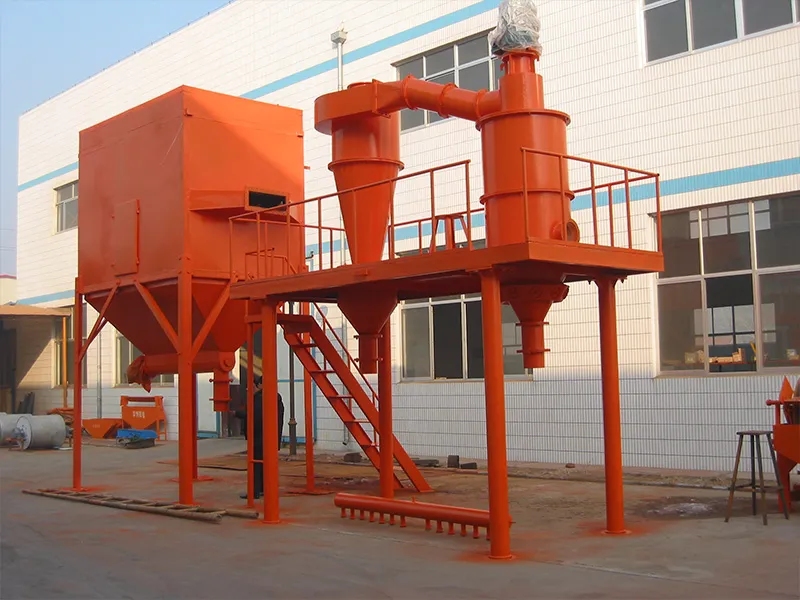
This article discovers the purpose, principles, and types of ultrafine powder classification equipment. Learn the differences between dry and wet methods, common classifiers like centrifugal and jet types, and their applications in modern industry.
Purpose and Significance of Classification
Mechanically produced ultrafine powders often cannot achieve the desired particle size in a single grinding pass, typically resulting in a wide particle size distribution. Modern industrial applications, however, frequently demand ultrafine powders with specific, controlled particle size distributions. Furthermore, during the grinding process, only a portion of particles usually reaches the target size, while others remain unqualified. If the qualified particles are not separated promptly and are instead reground alongside the unqualified ones, it not only wastes energy but can also lead to over-grinding of some material. Therefore, classification is an essential step in ultrafine powder production. It serves a dual purpose: controlling the product’s particle size distribution and efficiently separating qualified particles to enhance production efficiency and product quality.

Basic Principles of Classification
In a broad sense, classification involves separating particles into different groups based on differences in their properties such as size, density, color, shape, chemical composition, magnetism, or radioactivity.
In a narrower sense specific to particle size, classification relies on particles of different sizes experiencing different magnitudes of forces—like centrifugal force, gravity, and inertial force—within a medium, causing them to follow distinct trajectories and thus achieve separation.
Based on the medium used, ultrafine powder classification can be divided into dry and wetmethods.
- Dry Classification uses air as the medium. It offers low cost and convenient operation but faces challenges like potential dust pollution and sometimes limited classification precision.
- Wet Classification employs a liquid medium. It provides high classification precision and eliminates dust explosion risks. However, it requires additional downstream processes such as dewatering, drying, and wastewater treatment.
| Classification Method | Equipment Name | Classification Particle Size D97/μm | Processing Capacity |
| Dry Classification | MS Impeller Classifier | 3 ~ 150 | 50 ~ 12,000 kg/h |
| MSS Classifier | 2 ~ 45 | 30 ~ 8,000 kg/h | |
| ATP Classifier | 3 ~ 180 | 50 ~ 35,000 kg/h | |
| LHB Classifier | 5 ~ 45 | 500 ~ 10,000 kg/h | |
| O-Sepa Classifier | < 10 | 30 ~ 8,000 kg/h | |
| Wet Classification | GSDF Ultrafine Cyclone | 3 ~ 10 | 1 ~ 25 m³ (slurry) |
| Horizontal Spiral Centrifugal Classifier | 1 ~ 10 | 1 ~ 20 m³ (slurry) | |
| Small Diameter Hydrocyclone (Group) | 3 ~ 45 | 1 ~ 50 m³ (slurry) |
Introduction to Ultrafine Classification Equipment
A wide variety of ultrafine classification equipment exists today, primarily categorized into dry and wet types based on the fluid medium.
Dry classification equipment
Dry classification equipment can be further divided by working principle:
• Gravity Classifiers: Separate particles based on differences in their settling velocities within a gravity field. Common types include horizontal and vertical flow classifiers.
• Inertial Classifiers: Utilize differences in particle mass (and thus inertia) to create separate trajectories when the flow direction changes, enabling classification. Current devices can achieve classification down to about 1 micron. Effective suppression of particle agglomeration and eddy currents holds promise for achieving sub-micron classification with improved precision and efficiency.
• Centrifugal Classifiers: Achieve ultrafine classification by generating a strong centrifugal force field, representing a widely developed category. They can be subdivided by flow field type:
◦ Free Vortex Type: Includes models like DS and SLT.
◦ Forced Vortex Type: Includes models like MC, MS, MSS, ATP, MP, and turbine classifiers.
• Jet Classifiers: These devices integrate multiple principles including inertial classification, rapid classification, and the Coandă effect. Key features include:
1. No moving parts in the classification zone, ensuring easy maintenance and reliable operation.
2. Jet streams aid in pre-dispersing the powder.
3. Particles enter classification immediately after dispersion, effectively suppressing re-agglomeration.
4. Capable of producing multiple product fractions; particle size can be flexibly controlled by adjusting the classifier blade angle and outlet pressure.
5. High classification efficiency and precise cut size.
Wet classification equipment
Wet classification equipment mainly includes gravity-based hydraulic classifiers and centrifugal force-based hydraulic classifiers.
• Mechanical Classifier: Spiral Classifier: The discharge from a grinding mill enters this classifier. Qualified fine particles overflow, while coarse sand settled at the bottom is conveyed out by a rotating spiral or rake and returned to the mill for further grinding. It’s a medium-to-fine particle classifier primarily used in mineral processing circuits in conjunction with grinding mills.
• Cone Classifier: A simple design where slurry is fed continuously through a central feed pipe into the cone. It fills the cone and overflows from the top periphery. An upward and horizontal flow exists within the cone. Particles with a settling velocity greater than the upward flow velocity sink and are discharged as underflow (sand). Particles with lower settling velocities are carried upward by the flow, overflow into a launder, and are discharged as overflow.
• Hydrocyclone: For very fine particles, the centrifugal force field may be insufficient to overcome fluid-particle interactions (viscous drag, turbulent diffusion). The distribution of these ultra-fines between underflow and overflow approaches the distribution of water, meaning they essentially follow the water split.
• Decanter Centrifuge (Horizontal Solid-Bowl Centrifuge with Conveyor): Main components include a rotating bowl, a screw conveyor (scroll), a differential gear, a casing, and a base. The bowl and scroll rotate in the same direction at a slight speed difference. The feed enters the accelerating chamber and rotates almost synchronously with the bowl. Particles enter the centrifugal force field and separate rapidly. Fine particles overflow through an adjustable weir (overflow ring), while coarse particles settle against the bowl wall and are conveyed forward by the scroll for discharge as cake.
As an interdisciplinary field, the powder industry has gained significant attention in recent years, and ultrafine powder classification technology has seen rapid development. However, with the continuous advancement of high-tech industries and new materials, classification technology still faces numerous challenges. Therefore, further strengthening research into ultrafine classification technology and equipment remains of great importance.
Epic Powder
Epic Powder has 20+ years of work experience in the ultrafine powder industry.
Actively promote the future development of ultra-fine powder, focusing on crushing, grinding, classifying and modification process of ultra-fine powder.
We have mature solutions for various industries, including equipment selection, product process, mold selection, and auxiliary device selection. At the same time, for some special industries or products, we can also provide customized solutions to customers from the above aspects.

“Thanks for reading. I hope my article helps. Please leave a comment down below. You may also contact EPIC Powder online customer representative Zelda for any further inquiries.”
— Jason Wang, Senior Engineer