A GCC producer supplying both the plastics compounding market and the architectural paint market. It’s in practice, running two completely different products through the same classifier. The limestone is the same. The mill is the same. But the particle size distribution that a blown-film manufacturer needs is not the same with an emulsion paint formulator needs. Run both grades with identical classifier settings and one of them will be wrong — probably both.
The good news is that a dynamic air classifier gives you direct, continuous control over exactly these parameters. Rotor speed, airflow, and feed rate can all be adjusted to shift the cut point and narrow or broaden the distribution, without stopping the line. The practical question is knowing which direction to move each parameter, and by how much, when you switch from plastic-grade to paint-grade production.
This article covers what each market actually requires from GCC in physical terms. How those requirements translate into specific classifier settings? What real production lines look like when the settings are right and when they are not.
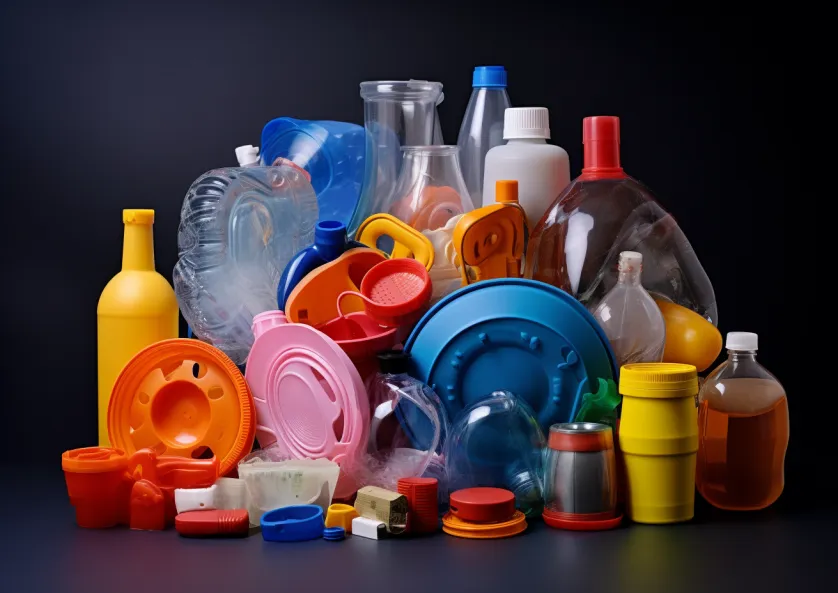
What Plastics and Paints Actually Require from GCC — and Why They Differ
GCC is used in both markets as a cost-effective filler, but the physical properties it needs to provide in the finished product are different enough that the required particle size distributions barely overlap.
Plastics: Coarser Distribution, Tight Top Cut
In plastics compounding — PVC pipe, polyethylene film, polypropylene compounds — GCC serves primarily as a cost-reducing filler and stiffening agent. The target particle size is relatively coarse by industrial mineral standards: D97 in the 15-25 micron range is typical for most plastics applications, with D50 often in the 5-12 micron range.
The critical parameter in plastics is not median size but top cut — the D97 or Dmax. A single oversized particle in a blown film application can nucleate a tear. In PVC pipe extrusion, coarse particles cause surface streaking and can create stress concentration points that reduce impact resistance. Most plastics processors specify a hard upper limit — sometimes D97 below 20 microns, sometimes Dmax below 45 microns — and they check for it on incoming material.
The other characteristic that matters in plastics is low specific surface area. Finer particles mean higher surface area, which means the filler absorbs more plasticiser and coupling agent — driving up formulation cost. For plastics producers who are loading GCC at 30-50% by weight to reduce compound cost, keeping surface area low enough to maintain processable viscosity is a real constraint. This argues against going finer than the application requires.
Paints: Finer Distribution, Narrow Span
In architectural paints — emulsion paint, primers, textured coatings — GCC does different work. Fine GCC in the D50 2-5 micron range contributes to hiding power through light scattering, improves opacity, and affects the rheology of the wet paint. The finer the particle, the higher the specific surface area, and the greater the binder demand — but also the better the gloss and smoothness of the dried film.
Paint formulators specify GCC more tightly than plastics processors in most cases. D50 and D90 are both specified, and the span — (D90-D10)/D50 — matters because a broad distribution with a mix of very fine and somewhat coarser particles produces uneven light scattering and inconsistent film formation. Coarse particles in a gloss paint formulation show up as visible grit in the dried film and cause gloss readings to drop.
Unlike plastics, the direction of error in paints is different: going too coarse ruins gloss and smoothness, while going slightly finer than spec is generally acceptable. But finer grinding costs more energy per tonne and reduces throughput — so precision matters economically as well as technically.
| Parameter | Plastics Grade GCC | Paint Grade GCC |
| Typical D50 | 5-12 microns | 2-5 microns |
| Typical D97 | 15-25 microns | <10 microns |
| Dmax / top cut | <45 microns (hard limit for film) | <15 microns for gloss paint |
| Span priority | Lower priority — throughput matters more | High priority — narrow span = consistent gloss |
| Specific surface area | Lower preferred (reduces oil absorption) | Higher accepted (contributes to hiding power) |
| Key quality failure mode | Coarse particles causing film tears or surface defects | Coarse grit causing gloss drop; broad span causing uneven film |
| Classifier priority setting | Top cut control at maximum throughput | D50 accuracy and span minimisation |
The Four Classifier Parameters That Control the Switch
A dynamic air classifier has four adjustable parameters that directly affect the product PSD. Understanding what each one does — and how they interact — is the foundation of switching cleanly between plastic-grade and paint-grade production.
1. Classifier Wheel Speed (Rotor Speed)
Rotor speed is the primary cut-point control. The spinning classifier wheel applies centrifugal force to particles at the wheel face. Higher wheel speed means higher centrifugal force. This rejects larger particles back to the mill and allows only finer ones through to product. Lower wheel speed relaxes the centrifugal barrier and allows coarser particles to pass.
For plastic-grade GCC (D97 15-25 microns), rotor speed sits at the lower end of the operating range. It’s typically 1,200-2,500 rpm depending on mill size, though the exact figure depends on the classifier geometry. For paint-grade GCC (D97 below 10 microns), rotor speed needs to increase substantially — typically 30-60% above the plastic-grade setting. This is the single largest parameter change between the two grades.
One important interaction: higher rotor speed reduces throughput. The classifier is rejecting a higher fraction of feed back to the mill, so the circuit’s circulating load rises and net product output falls. This is why paint-grade GCC consistently costs more per tonne to produce than plastic-grade from the same raw material — the energy and throughput penalty of finer classification is real.
2. Airflow Velocity
Airflow velocity determines how quickly particles are transported from the mill to the classifier and how forcefully they are presented to the classifier wheel. Higher airflow brings particles to the wheel faster and at higher velocity — which increases the drag force competing with centrifugal rejection.
For plastic-grade production, airflow is typically set to maximise throughput. It’s high enough to carry the coarser product efficiently without creating excessive pressure drop. For paint-grade production, the relationship between airflow and rotor speed needs careful balancing. Too high an airflow at high rotor speed pushes coarser particles through the wheel against the centrifugal barrier, widening the cut and increasing D97 — the opposite of what you want. Paint-grade classification generally runs at moderate to lower airflow, with the rotor speed doing the fine-cut work.
The practical adjustment when switching from plastic to paint grade: increase rotor speed first, then reduce airflow in 5-10% steps while monitoring product D97. The target is the highest throughput at which D97 remains within the paint specification.
3. Feed Rate
Feed rate affects particle concentration in the classification zone. At high feed rates, the concentration of particles near the classifier wheel is high enough that particle-particle interactions influence which particles get classified. It’s a phenomenon called crowding effect. The result is that the effective cut point shifts coarser as feed rate increases, because particles are hindering each other’s classification.
For paint-grade GCC, this means running at a lower feed rate than for plastic-grade — which again adds to the energy cost per tonne. Keeping feed rate constant and stable (using a controlled vibratory or screw feeder) is more important for paint-grade production, where D97 must be held tightly, than for plastic-grade, where a slightly coarser product is acceptable if throughput is maximised.
4. Reject Recirculation and Circulating Load
In a closed-circuit system, the material rejected by the classifier returns to the mill for further grinding. The circulating load rises as you move to finer classification. It’s because a higher fraction of each pass through the classifier is rejected. For paint-grade GCC, circulating loads of 200-400% are common. For plastic-grade, 100-200% is typical.
A high circulating load is not a problem in itself, but it has two consequences worth monitoring. It increases the residence time of material in the circuit and it increases the energy consumption of the mill motor. If circulating load rises above 400%, it usually signals either that the feed material is harder than the mill was sized for or that the classifier cut point has been set finer than the circuit can efficiently sustain.
| Parameter Adjustment Summary: Switching from Plastic to Paint Grade Rotor speed: Increase by 30-60% from plastic-grade setting. This is the primary control variable. Airflow: Reduce by 10-20% from plastic-grade setting after rotor speed is set. Prevents over-coarsening of the cut. Feed rate: Reduce by 15-25%. Lower concentration in the classification zone improves cut sharpness. Circulating load: Expect it to rise — 200-400% is normal for paint grade. Above 400%, investigate mill capacity or raw material hardness. Monitoring: Sample product PSD every 30 minutes during the first 2 hours of a grade change. Allow steady state to establish before committing to a parameter recipe. |
Two Grade Changes That Went Different Ways
CASE STUDY 1
PVC Pipe Producer: Coarse Particles Causing Surface Streaking — Fixed by Rotor Speed and Airflow Adjustment
The situation
A PVC pipe manufacturer was receiving GCC from a supplier running a ring roller mill with a dynamic air classifier. The specification was D97 below 22 microns, Dmax below 45 microns. Intermittent surface streaking on extruded pipe was traced back to incoming GCC batches with D97 readings of 28-32 microns — above spec — and occasional particles above 50 microns detected by Coulter counter analysis on production samples.
What was wrong
The GCC supplier’s classifier rotor speed had drifted 12% below the set point due to belt wear — a gradual change that had gone undetected because daily PSD checks were done by sieve analysis (325 mesh) which cannot reliably detect particles in the 25-50 micron range. The effective cut point had moved from D97 21 microns to D97 29 microns over approximately three months of operation.
The fix and result
Rotor speed was restored to set point with a new belt and tensioner. Airflow was simultaneously reduced by 8% (from where it had been to compensate for the drifted cut point). Laser diffraction monitoring was added at the classifier product outlet.
D97: returned to 20 microns within one production shift of the adjustment
Dmax: below 38 microns on all subsequent batches
Pipe surface defects: eliminated — no streaking reported in the following six months
PSD monitoring: upgraded to in-line laser diffraction, removing the lag that had allowed the drift to continue undetected
CASE STUDY 2
Paint Manufacturer: Poor Gloss from Coarse Particles — Resolved by Tightening the Top Cut
The situation
A producer of semi-gloss emulsion paint was experiencing lot-to-lot variation in 60-degree gloss readings of ±8 gloss units — enough to cause colour-matching problems and occasional customer complaints about visible grit in the dried film. Their GCC was specified at D50 3.5 microns, D98 below 12 microns. ICP analysis ruled out contamination. Particle size testing on retained samples showed that the D98 was varying between 10 and 18 microns across different GCC batches from the same supplier.
What was wrong
The GCC supplier was running paint-grade and plastic-grade GCC on the same classifier with an incomplete grade-change protocol. After switching from plastic to paint grade, the classifier was allowed to reach steady state by time (30 minutes) rather than by PSD confirmation. Residual plastic-grade material in the circuit — with its higher D97 — was carrying over into the first paint-grade batches of each production run. The D98 spikes corresponded exactly with batches produced in the first hour after a grade switch.
The fix and result
A formal grade-change protocol was introduced: after switching rotor speed and airflow settings, the first 200 kg of product after a grade change is collected as a separate holding batch and tested before being released to the paint-grade product stream. Samples are taken every 15 minutes and must show D98 below 12 microns on two consecutive samples before the holding batch is reclassified as on-spec.
D98 conformance: 100% on released paint-grade batches in the three months following protocol introduction
Gloss unit variation: reduced from ±8 to ±2.5 GU across production lots
Customer complaints: zero in the six months following the change
Holding batch volume: average 180 kg per grade change — reclassified as plastic-grade GCC at no loss of value
A Practical Guide to Running Both Grades on One Line
If your classifier line needs to produce both plastic-grade and paint-grade GCC, the following practices make the difference between a smooth multi-grade operation and one where every grade change costs you a batch of rejects.
Build Separate, Validated Parameter Recipes
Do not rely on operator memory or hand-written notes for grade-change settings. Store the validated rotor speed, airflow, and feed rate settings for each grade as named recipes in the classifier control system. A validated recipe means: these settings have been confirmed by laser diffraction analysis to consistently deliver the target PSD at steady state. Treat them as locked unless a formal re-validation is done.
Define a Grade-Change Protocol with PSD Confirmation
Never declare a grade change complete by time alone. Steady state after a classifier parameter change depends on the circulating load in the circuit at the time of the change — it can take 20 minutes or 90 minutes depending on conditions. The only reliable trigger for releasing product to the new grade stream is two consecutive on-spec PSD measurements, not a fixed elapsed time.
Use a Holding Batch, Not a Flush
The material produced immediately after a grade change is transitional — it will contain some of the previous grade’s PSD characteristics. Rather than flushing this material to waste, collect it as a holding batch. Test it. In most cases, transitional material from a coarse-to-fine switch will be slightly coarser than the fine target but still within the coarse-grade specification. Reclassify it and move it to the appropriate product stream rather than discarding it.
Monitor D97 and D10 Separately
Most GCC producers track D50 as their primary process control metric. For multi-grade operations, this is insufficient. D97 is the critical number for plastics (top cut control) and D10 is relevant for paints (controlling the fine tail that drives surface area and viscosity). Add both to your in-process monitoring. An in-line laser diffraction instrument that logs D10, D50, D90, and D97 continuously is worth the investment on a multi-grade classifier line.
| Running Both Plastics and Paint Grades on the Same Classifier? EPIC Powder Machinery’s application engineers work with GCC producers who supply multiple markets from a single production line. If you are trying to hit tighter specifications, reduce rejects between grade changes, or cut the energy cost of producing fine paint-grade powder, we can run your material through our test facility and give you specific parameter recommendations based on your actual feed.No commitment required — we provide a full PSD report, recommended rotor speed and airflow settings, and a classifier configuration recommendation. Request a Free Process Consultation: www.powder-air-classifier.com/contact Explore Our GCC Classifier Range: www.powder-air-classifier.com |
Frequently Asked Questions
Can the same classifier run both plastic-grade and paint-grade GCC without contamination?
Yes, provided you follow a proper grade-change protocol. The main contamination risk is residual coarse material from a plastic-grade run carrying over into the first paint-grade batches. This shows up as elevated D97 and D98 in the paint product, which causes gloss problems. The solution is a holding batch protocol: collect the first 150-250 kg of product after a grade change separately, confirm by laser diffraction that D97 is within the paint-grade specification on two consecutive samples, and only then release product to the paint-grade stream. Residual material from a fine-to-coarse switch (paint to plastic) is less problematic. Slightly fine material in a plastic-grade batch rarely causes defects, though it does increase oil absorption modestly.
What is the most important single setting difference between plastic-grade and paint-grade GCC classification?
Classifier rotor speed, by a significant margin. Rotor speed is the primary control variable for cut point — it determines where the centrifugal barrier sits and therefore which particles are rejected back to the mill and which pass through to product. Going from a typical plastic-grade D97 of 20 microns to a paint-grade D97 of 8 microns typically requires a rotor speed increase of 40-70%, depending on the classifier design and the raw material characteristics. Airflow and feed rate are secondary adjustments that fine-tune the distribution shape and throughput once rotor speed has set the approximate cut point. If you only have time to change one parameter in an emergency grade switch, change rotor speed.
How does limestone hardness affect classifier settings for GCC?
Limestone hardness (Mohs 3-4 for calcite, up to 5 for harder impure limestones) affects the upstream mill more directly than the classifier itself, but the effect propagates. Harder limestone produces a feed to the classifier that has a higher proportion of coarser particles, because the mill is less efficient at size reduction per unit of energy. This means the circulating load rises for the same classifier settings — the classifier rejects more material, which goes back to the mill and struggles to reduce it further. In practice, if your raw material hardness increases, you will see D97 drift coarser for the same rotor speed setting and may need to increase rotor speed by 5-10% to maintain spec. If D97 is drifting and nothing has changed in your classifier settings, a change in raw material hardness is one of the first things to check.
If I slow down the classifier rotor for plastic-grade GCC, will oversized particles contaminate the product?
Not if your classifier is operating correctly. A dynamic air classifier does not let particles above the cut point ‘slip through’ when rotor speed is lowered — it simply moves the cut point to a coarser size. Particles above the new cut point are still centrifuged back to the grinding zone. The risk is not slipping coarse particles through, but rather that the new coarser cut point might be coarser than your plastic-grade specification allows. Before lowering rotor speed for a plastic-grade run, verify that the resulting D97 at your target cut point still meets the top cut requirement. Run a short trial at the new settings, sample the product, and confirm D97 is within spec before committing to a full production run.
Does regrinding plastic-grade GCC to produce paint-grade make sense?
Rarely, and only as an emergency measure. The fundamental problem with regrinding is that you are paying twice for size reduction: once to produce the plastic-grade product, and again to reduce it further to paint grade. The specific energy (kWh per tonne) for fine grinding is substantially higher than for coarse grinding — a reasonable estimate is that going from D97 20 microns to D97 8 microns requires 2-3 times the specific energy of producing the D97 20-micron product in the first place. There is also a morphology effect: regrinding a product that has already been classified tends to produce a broader distribution with more fines than classifying fresh mill feed to the same D97 target. The result is higher oil absorption and poorer rheology in the paint formulation. It is almost always more economical to produce paint-grade directly from fresh feed by adjusting classifier settings rather than regrinding plastic-grade stock.
Epic Powder
Epic Powder, 20+ years of experience in the ultrafine powder industry. Actively promote the future development of ultra-fine powder, focusing on crushing, grinding, classifying and modification process of ultra-fine powder. Contact us for a free consultation and customized solutions! Our expert team is dedicated to providing high-quality products and services to maximize the value of your powder processing. Epic Powder—Your Trusted Powder Processing Expert!

“Thanks for reading. I hope my article helps. Please leave a comment down below. You may also contact EPIC Powder online customer representative Zelda for any further inquiries.”
— Emily Chen, Engineer