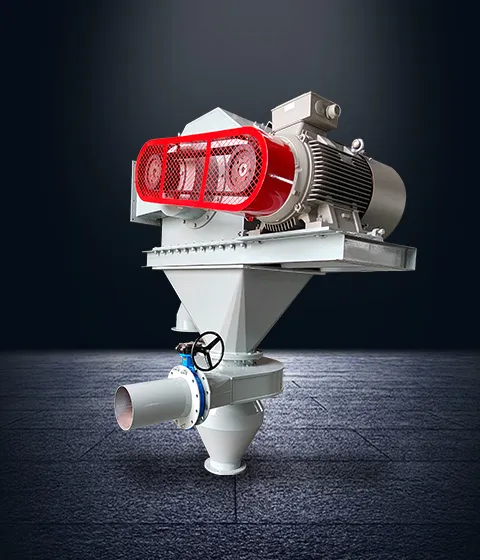
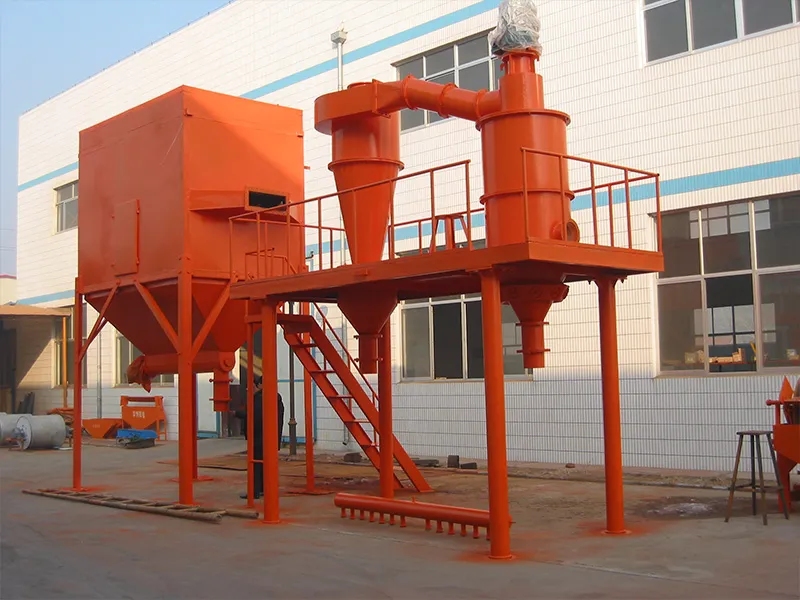
The Turbo Air Classifier, also known as a Turbo Classifier or Dynamic Air Classifier, is a highly efficient device widely used for the dry classification of ultrafine powders. It is particularly suitable for powder industries with stringent requirements on particle size distribution, high product purity, and large processing capacities, such as battery materials, electronic ceramics, pharmaceuticals, coatings, and deep processing of non-metallic minerals.
Ⅰ. Working Principle
The Turbo Air Classifier operates based on the balance between centrifugal force and airflow drag to achieve particle classification:
Powder Feeding: Dry powder is conveyed into the classification chamber under the action of an induced draft fan.
Dispersion and Deagglomeration: Particle agglomerates are broken up via a high-speed rotating dispersion disc or airflow shear.
Classification Process: The airflow carries the powder into the region of high-speed rotating turbine blades. ◦ Fine Particles: Experience centrifugal force < airflow drag → pass through the blade gaps → enter the fine powder outlet. ◦ Coarse Particles: Experience centrifugal force > airflow drag → are flung toward the outer wall → settle along the wall and descend to the coarse powder outlet.
Product Collection: Fine powder is recovered via a cyclone separator or bag filter; coarse powder can be recycled back to the grinding process. A key point to note is the control of the cut size, which can be precisely adjusted by regulating the rotational speed of the classifying wheel (higher speed → smaller d50). Of course, the actual particle size distribution is also influenced by system airflow rate, feed concentration, particle density, and other factors.
Ⅱ. Basic Structure
Component
Function Description
Feed Inlet
Receives powder from the mill or feeding system, usually connected to a cyclone separator or elevator.
Dispersing Disc / Flow Guide Device
Initially de-agglomerates clustered particles and ensures uniform entry into the classification zone.
Classifying Wheel (Turbo Rotor)
Core component; generates a strong centrifugal field through high-speed rotation to control the cut size.
Drive Motor & Main Shaft
Provides the required rotational speed for the classifying wheel (typically 3000-12000 rpm), equipped with variable frequency drive for speed adjustment.
Housing & Classification Chamber
Forms the gas-solid two-phase flow channel, optimizing the flow field distribution.
Coarse Powder Outlet (Return Port)
Discharges oversized coarse particles, which can be returned to the mill for regrinding.
Fine Powder Outlet (Product Port)
Qualified fine powder exits with the airflow into the subsequent collection system (e.g., bag filter).
Sealing & Bearing Cooling System
Prevents dust leakage and ensures stable operation at high speeds.
Ⅲ. Main Types
Industry
Application Material
Classification Requirements
Lithium Battery
Graphite Anode, LFP, NMC Materials
Dt = 5–15 μm, narrow distribution, low impurities
Non-Metallic Minerals
Ultrafine GCC, Kaolin, Talc Powder
High whiteness, ds:≤10 μm
Electronic Ceramics
Alumina, Zirconia, Barium Titanate
Uniform particle size, free of large particles
Pharmaceutical & Chemical
API Raw Material, Catalyst Support
GMP compliant, no cross-contamination
Metal Powder
Aluminum Powder, Copper Powder, Silicon Powder
Inert gas protection required, anti-oxidation/explosion proof
Ⅳ. Core Advantages and Limitations
Advantages
Limitations
High Precision Classification: Cut size can be precisely controlled, resulting in a narrow particle size distribution (high steepness index).
✕ Not suitable for sticky, high-moisture, or easily re-agglomerating materials(pre-drying or surface modification may be required).
Dry Process Operation: No water required, saving drying energy; suitable for heat-sensitive or water-sensitive materials.
✕ Classification efficiency decreases for ultra-fine powders (<0.5 µm), where electrostatic or inertial classification may be needed in combination.
Continuous Automation: Capable of 24/7 continuous operation, easily integrated into intelligent production lines.
✕ Relatively high equipment investment, especially for high-speed, high-purity models.
High Product Purity: Fully enclosed design minimizes contamination; can be operated with inert gas protection (e.g., nitrogen).
High Flexibility: Product fineness can be changed simply by adjusting rotational speed, without hardware replacement.
✕ Noise and Vibration: High-speed rotation necessitates good vibration damping and sound insulation measures.
Energy Efficient: Lower overall energy consumption compared to wet process + drying workflows.
Ⅴ. Key Technical Indicators
Parameter
Typical Range
Cut Size (d50)
1 – 100 μm (Primary applications: 3-45 μm)
Classification Efficiency
≥85% (Can exceed 95% under ideal conditions)
Speed Range
3000 – 12000 rpm (Model dependent)
Processing Capacity
From tens of kg/h to several tons/hour
Product Particle Size Distribution(Span)
Span = (d90- d10)/d50; High-quality equipment can achieve ≤1.0
Power Consumption
Relatively low; primary energy consumption is from the fan and motor.
Ⅵ. Application Scenarios
Industry
Application Material
Classification Requirements
Lithium Battery
Graphite Anode, LFP, NMC Materials
Dt = 5–15 μm, narrow distribution, low impurities
Non-Metallic Minerals
Ultrafine GCC, Kaolin, Talc Powder
High whiteness, ds:≤10 μm
Electronic Ceramics
Alumina, Zirconia, Barium Titanate
Uniform particle size, free of large particles
Pharmaceutical & Chemical
API Raw Material, Catalyst Support
GMP compliant, no cross-contamination
Metal Powder
Aluminum Powder, Copper Powder, Silicon Powder
Inert gas protection required, anti-oxidation/explosion proof
Epic Powder
Superfine Turbo Air Classifier by Epic Powder
The Turbo-Twin Double Classifier is a top-notch particle separator. It works well for classifying soft to medium-hard minerals. Plus, it handles high throughputs, making it great for industrial fillers. The classifying wheel features a new patented design. It allows for high throughput rates and loading factors with fineness values of up to d97 = 3.0 μm. The EPIC TDC Ultra-fine Air Classifier has a low pressure drop. This feature makes it one of EPIC powder’s most energy-efficient air classifiers. The classifying wheel has support bearings on each side. It allows very high peripheral speeds, reaching up to 120 m/s. Another unique feature is the improved product routing to the classifying wheel. This change stops back mixing with the already classified coarse material. Six models are available for pilot classification systems in large production units. Contact us to have your tailor-made solution today.
“Thanks for reading. I hope my article helps. Please leave a comment down below. You may also contact EPIC Powder online customer representative Zelda for any further inquiries.”