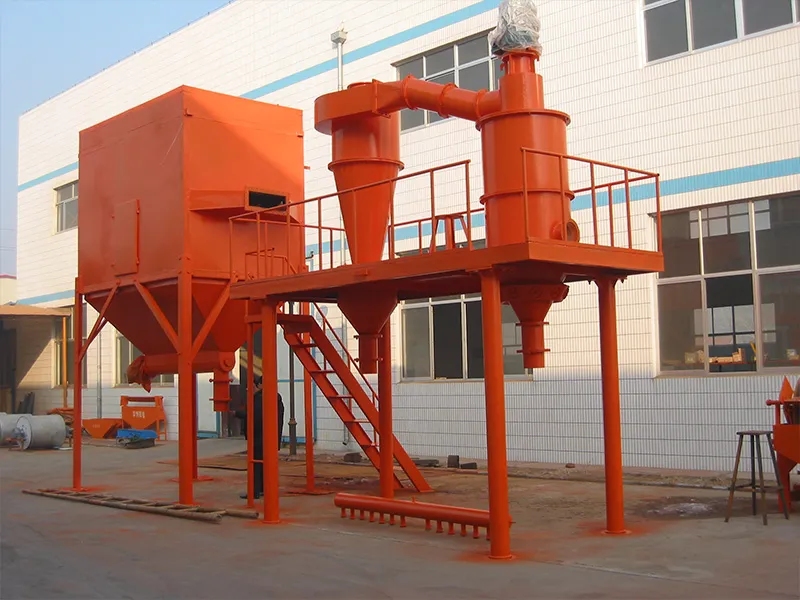
The CTC centrifugal classifier and the MBS powder separator both classify dry mineral powder by particle size. That is where the similarity ends. The CTC is a self-contained single unit: no cyclones, no bag filters, no external fan — the material enters, classifies, and both fractions discharge from the bottom. The MBS requires a full system: classifier, cyclone collector, dust collector, fan, and interconnecting ductwork. One machine versus a complete installation.
This architecture difference is not arbitrary — it reflects a fundamental trade-off between simplicity and precision. The CTC’s self-contained design limits how fine and how high-volume it can operate. The MBS’s external system architecture is what enables it to reach D97 below 15 microns at throughputs above 100 t/h. Understanding this trade-off is the core of the selection decision.
At EPIC Powder Machinery, we supply both systems. This article compares them on the parameters that actually drive equipment selection: operating principle, fineness range, capacity, system cost, wear performance, and application fit — with real production data from operations running each technology.
CTC Centrifugal Classifier: How It Works and Where It Fits
The CTC classifier achieves size separation entirely within a single housing using internal air circulation. Material feeds in from the top, falls onto a rotating bulk pan that disperses the feed into an adjustable internal airflow. Fine particles are entrained in the airflow and carried to the outer collection chamber; coarse particles fall inward under gravity and centrifugal force into the inner chamber. Both fractions discharge from the bottom through rotary airlocks. No external fan, no cyclone, no bag filter — the internal fan generates and circulates the classification air entirely within the machine.
What This Design Enables
•Compact footprint: the classifier occupies a single floor area footprint with no satellite equipment. Ideal for retrofitting into existing plant buildings with limited space.
•Low capital cost: no cyclone, dust collector, fan, or ductwork to purchase and install. Total installed cost is substantially lower than an equivalent MBS system.
•Simple maintenance: one machine with one drive system. Fewer components means fewer scheduled maintenance items and fewer potential failure points.
•Wear resistance: internal contact surfaces can be lined with alumina ceramic or polyurethane for abrasive materials such as quartz, corundum, silicon carbide, and marble.
CTC Operating Range and Limitations
The CTC handles D97 from 32 to 250 microns with feed rates up to 48 t/h. These constraints come directly from the self-contained design. The internal fan cannot generate the high, uniform airflow velocities needed for very fine classification — below D97 30 microns, the drag forces required to carry fine particles against gravity in the internal circuit are not achievable with this architecture. At very high feed rates, the internal classification zone becomes overloaded and separation sharpness degrades.
For the applications it suits — coarse-to-medium mineral classification, standalone purification of hard minerals, small-to-medium scale operations — these are not limitations. They are simply the boundary of the technology’s design envelope.
MBS Powder Separator: How It Works and Where It Fits
The MBS operates with externally supplied classification air. Feed material enters from the top inlet, falls onto a centrifugal dispersion disc, and is spread evenly into the classification zone. Classification air is drawn in from outside the machine, passes through adjustable guide vanes, and flows radially inward toward the classification wheel. The guide vanes ensure uniform velocity distribution around the full circumference of the wheel — this uniformity is what produces a sharp cut rather than a broad transition.
Fine particles are carried inward with the airflow, pass through the classifier wheel, and are conveyed pneumatically to the cyclone collector (primary product recovery) and bag filter (fine fraction recovery and clean air exhaust). Coarse particles are thrown outward by the centrifugal force of the classifier wheel, fall to the base of the classifier housing, and are discharged for return to the mill.
What This Design Enables
• Fine cut points: external high-velocity airflow enables classification down to D97 8 microns — unachievable by internal-circulation designs at production scale.
• High throughput: 18 models from 4 t/h to 840 t/h. The largest MBS units process more material in one hour than the largest CTC processes in nearly 18 hours.
• Sharp PSD: adjustable guide vanes and wheel geometry produce a narrow transition zone between fine and coarse fractions — the tight span required for premium coating, plastics, and electronics applications.
• Closed-circuit integration: designed for direct connection to ball mill grinding circuits. The coarse reject stream returns to the mill; the product exits the cyclone at the target D97. This closed loop is what makes energy-efficient ultra-fine grinding possible.
MBS System Requirements
The external system architecture requires space, capital, and infrastructure. A complete MBS installation includes the classifier, a cyclone collector (primary product), a bag filter (fine fraction and air cleaning), an induced-draft fan, and interconnecting ductwork. For large models, the classifier drive alone runs to 630 kW. Total installed system cost is substantially higher than a CTC installation. This is the justified cost of the precision and capacity the MBS delivers.
Side-by-Side Comparison
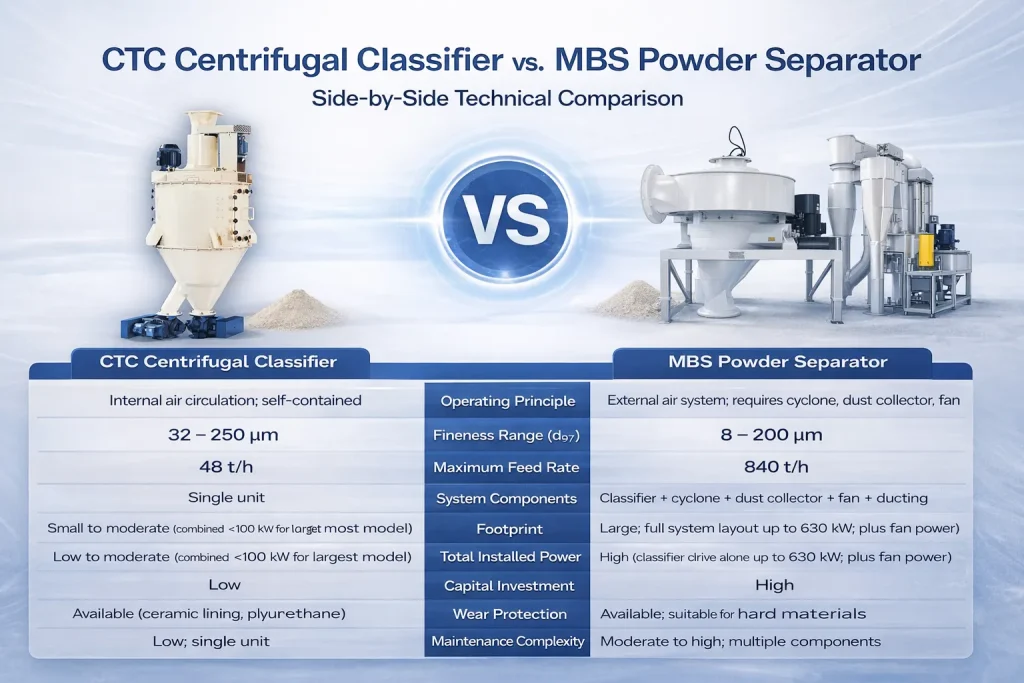
| Parameter | CTC Centrifugal Classifier | MBS Powder Separator |
| Operating principle | Internal air circulation; self-contained | External air system; requires cyclone, bag filter, fan |
| Fineness range (D97) | 32-250 um | 8-200 um |
| Maximum feed rate | 48 t/h | 840 t/h |
| System components | Single unit only | Classifier + cyclone + bag filter + fan + ductwork |
| Floor space required | Machine footprint only | Full system layout — 3-5x CTC footprint |
| Total installed power | Low-moderate (< 100 kW largest model) | High (classifier up to 630 kW + fan power) |
| Capital investment | Low | High |
| Maintenance complexity | Low — single unit, single drive | Moderate — multiple components, multiple wear points |
| Wear protection | Ceramic lining or polyurethane (internal) | Wear-resistant wheel, vanes, cyclone, ducting |
| Cut point precision | Moderate | High — tight PSD for premium applications |
| Closed-circuit mill integration | Limited | Designed for this; standard configuration |
Decision Framework: Which Technology for Which Application
The selection decision comes down to three numbers: your target D97, your required throughput, and your available capital budget.
Use the CTC when:
- Target D97 is 32-250 microns: Below 32 microns, the internal circulation design cannot maintain the airflow precision required for a sharp cut
- Production volume is below 40-50 t/h: Above this rate, CTC classification sharpness degrades as the internal zone becomes overloaded
- Space is constrained: Single-unit footprint — retrofits into existing buildings that cannot accommodate a full MBS system
- Capital budget is limited: Significantly lower total installed cost vs. MBS; faster payback on lower-margin mineral products
- Material is hard and abrasive: Quartz, corundum, silicon carbide, marble — fewer wear-prone components than MBS system
- Operation is standalone (no mill): CTC works as a standalone classifier; no mill integration required
Use the MBS when:
- Target D97 is below 32 microns: Especially 8-20 microns for GCC, talc, silica, graphite — the CTC cannot achieve these cut points
- Production volume exceeds 50 t/h: MBS scales to 840 t/h; CTC tops out at 48 t/h
- Integrating with a ball mill circuit: Closed-circuit ball mill + MBS is the standard configuration for fine mineral powder production
- Product commands premium pricing: Ultra-fine GCC for coatings, talc for plastics, electronics-grade silica — the margin justifies the higher system investment
- Tight PSD span is specified: Paint and plastics customers often specify span as well as D97; MBS precision achieves these narrow distributions
- Throughput growth is anticipated: Scale from MBS-5 to MBS-18 with the same design — investment scales with production volume without technology change
Real Production Results: CTC and MBS on Hard Mineral Materials
CASE STUDY 1
CTC for Quartz Sand Purification — Standalone Operation at 35 t/h
The situationA quartz sand producer needed to classify run-of-mine quartz into a coarse glass-grade fraction (D97 120-150 microns) and a fine fraction for coatings applications (D97 45-55 microns). Their existing vibrating screen was handling the coarse separation adequately but could not produce a clean 45-55 micron cut on the fine side. They had no existing mill circuit and needed a standalone classifier that could be installed in a standard industrial building without major civil works.
The solution and results
EPIC Powder Machinery supplied a CTC with ceramic-lined internal components for quartz service. The unit was installed in a single afternoon and commissioned within one day.
- D97 of fine fraction: 48.6 microns, consistently within the 45-55 micron target
- D97 of coarse fraction: 138 microns — clean separation with minimal fines carryover to the coarse stream
- Throughput: 34.5 t/h — within the 35 t/h design target
- Installation: one unit on a single concrete pad; no external fan, cyclone, or ductwork required; total installation time under two days
- Maintenance after 2,000 hours: ceramic-lined internal components showed minimal wear; estimated service interval 8,000+ hours
CASE STUDY 2
MBS for Ultra-Fine GCC — Closed-Circuit with Ball Mill at D97 18 Microns
The situation
A calcium carbonate producer supplying the paint and coatings market needed to produce D97 18 microns at 120 t/h from a ball mill circuit. This fineness is outside the CTC’s operating range — an MBS in closed circuit with the ball mill was the only dry classification option at this production volume. Their previous air separator was producing D97 22-28 microns and limiting their market to lower-value construction fillers rather than the premium coatings market.
The solution and results
EPIC Powder Machinery supplied an MBS-9 integrated with the existing ball mill in a closed-circuit configuration. The MBS’s fine cut capability and sharp PSD were the enabling factors for this application.
- Product D97: 18.4 microns, consistently within specification
- Throughput: 118 t/h — above the 120 t/h target after parameter optimisation
- Energy saving: 15% reduction in total system power vs. previous separator
- Market access: product qualified for paint and coatings customers at 2-3x the price per tonne of their previous construction filler grade
Second unit: ordered within 6 months for a new production line
| Not Sure Whether CTC or MBS Is Right for Your Application? EPIC Powder Machinery supplies both the CTC centrifugal classifier and the MBS powder separator. If your application sits at the boundary between the two technologies — D97 in the 25-45 micron range, or capacity around 40-60 t/h — a material trial at our test facility is the most reliable way to confirm which gives you the better combination of product quality, energy cost, and total investment. Send us your feed material and target specification and we will run trials on both systems.Free material testing and equipment consultation available before any purchase commitment. Request a Free Material Trial: www.powder-air-classifier.com/contact Explore CTC and MBS Classifiers: www.powder-air-classifier.com |
Frequently Asked Questions
Is there an overlap zone where both CTC and MBS could work — and how do I choose in that range?
Yes. The overlap zone is approximately D97 32-50 microns at throughputs below 40 t/h. In this range, both technologies are technically capable. The decision comes down to economics and future plans. If your target D97 is in the 35-50 micron range and you have no plans to produce finer grades, the CTC delivers the same product at significantly lower capital cost and simpler operation.
There is no reason to invest in the MBS system complexity for this specification. If you are likely to want D97 below 30 microns in the future, or if you plan to grow throughput beyond 50 t/h, the MBS’s scalability and finer capability makes it the better long-term investment even if it is over-specified today. If you are genuinely uncertain, a material trial on both systems at our test facility gives you real PSD data and energy consumption figures on your actual feed material. It makes the economic comparison concrete rather than estimated.
Can the CTC handle the same material as the MBS — is the MBS strictly for finer applications?
The CTC can classify many of the same materials as the MBS — quartz, calcium carbonate, talc, marble — but only within its D97 range of 32-250 microns and at throughputs up to 48 t/h. For applications in this range, the CTC is often the better choice for cost and simplicity reasons. The MBS is not strictly a finer only system . It operates up to D97 200 microns and is suitable for the same minerals. But at D97 above 32 microns with capacity below 50 t/h, the CTC’s simpler, cheaper design is usually the correct engineering choice unless there is a specific reason to prefer the MBS (such as existing plant infrastructure already sized for a full classification system, or future plans to produce finer grades). The MBS’s advantages over the CTC — finer cut point, higher throughput, sharper PSD — are only fully realised when the application actually requires them.
How does wear protection differ between the CTC and MBS when processing abrasive minerals like quartz?
Both systems can be configured with wear-resistant materials, but the scope of the wear protection work differs significantly. In the CTC, wear protection consists primarily of lining the internal bulk pan, the inner and outer chamber walls, and the internal fan blades with alumina ceramic or polyurethane. This is a contained, limited scope of work. The simplicity of the single-unit design means there are fewer wear surfaces to protect.
In the MBS system, wear protection covers the classifier wheel and housing, the guide vanes, the cyclone collector walls, the inlet ducting, and any other surfaces in the product stream. This is a more extensive scope that requires more initial investment and more scheduled maintenance attention across more components. For pure wear economics on abrasive minerals at moderate throughput and medium fineness, the CTC’s simpler wear protection often makes it the lower total-cost-of-ownership option. For fine classification at high throughput where the MBS is required, the more extensive wear protection is an accepted part of the system cost.
Epic Powder
At Epic Powder, we offer a wide range of equipment models and tailor solutions to meet your specific needs. Our team has more than 20 years experience in various powders processing. Epic Powder is specialized in fine powder processing technology for mineral industry, chemical industry, food industry, pharama industry, etc.
Contact us today for a free consultation and customized solutions!

“Thanks for reading. I hope my article helps. Please leave a comment down below. You may also contact EPIC Powder online customer representative Zelda for any further inquiries.”
— Jason Wang, Engineer