What Is Wollastonite? Key Properties And Market Overview
Wollastonite is a natural mineral with the chemical formula CaSiO₃, known for its unique acicular (needle-like) crystal structure. This fibrous shape delivers distinct physical properties ideal for various industrial applications. Wollastonite powder typically needs to meet strict fineness standards, often aiming for a D97 of 5–15 μm. Achieving this efficiently while maintaining quality and preserving its needle-like structure challenges traditional grinding and classification techniques.
Key Properties of Wollastonite
| Property | Description |
|---|---|
| Chemical Composition | Calcium Silicate (CaSiO₃) |
| Crystal Structure | Naturally acicular, needle-like crystals |
| Brightness | High brightness enhances whiteness |
| Oil Absorption | Low oil absorption reduces cost in formulations |
| Thermal Stability | Stable under high temperatures |
| Reinforcement | Improves mechanical strength and dimensional stability |
These properties differentiate wollastonite as a preferred filler and reinforcement agent across many sectors.
Global Production and Mining
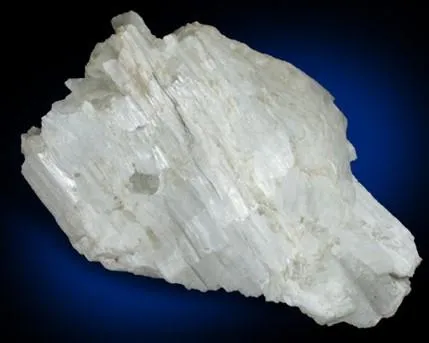
Wollastonite is primarily mined in countries with extensive mineral deposits:
- China – Leading global producer with large-scale mining operations
- India – Significant reserves supplying the Asia market
- USA – Established production with consistent quality
- Mexico – Growing contributor to North American supply
Wollastonite vs. Alternatives
| Attribute | Wollastonite | Talc | Kaolin | Calcium Carbonate |
|---|---|---|---|---|
| Particle Shape | Needle-like (acicular) | Plate-like | Fine, plate-like | Irregular, granular |
| Oil Absorption | Low | High | Moderate | Moderate |
| Brightness | High | Moderate | High | High |
| Thermal Stability | Excellent | Poor | Moderate | Good |
| Reinforcement | Strong | Limited | Limited | Limited |
Wollastonite’s combination of high aspect ratio, brightness, and thermal stability often outperforms traditional fillers like talc, kaolin, and calcium carbonate, especially where reinforcement and durability are critical.
By combining its unique chemical and physical features, wollastonite continues to hold a strong position in global mineral markets, serving demanding industries needing superior filler performance.
Applications of Wollastonite Powder
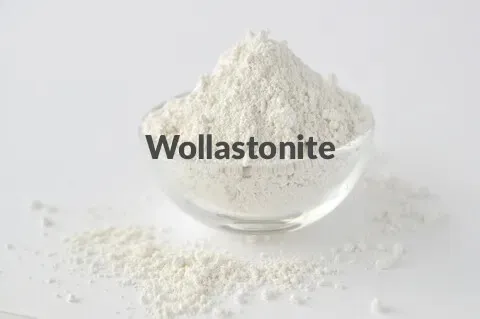
Wollastonite powder plays a crucial role across various industries thanks to its unique properties. In plastics and composites, it acts as a strong reinforcement filler, boosting impact resistance and improving dimensional stability. This helps manufacturers produce tougher, longer-lasting parts that maintain their shape under stress.
In paints and coatings, wollastonite serves as an effective extender pigment. It enhances coverage, provides a smooth matte finish, and improves anti-corrosion performance, making coatings more durable and visually appealing.
In the ceramics industry, wollastonite acts as a valuable fluxing agent, lowering firing temperatures while increasing mechanical strength. Its acicular nature helps strengthen ceramic bodies, resulting in improved toughness.
Beyond these traditional uses, wollastonite is gaining traction in rubber, adhesives, and other emerging applications where its needle-like structure and chemical stability enhance product performance.
A key factor in all these uses is the particle size and aspect ratio of the wollastonite powder. High aspect ratio needles offer better reinforcement, while a controlled particle size distribution ensures consistent processing and end performance.
For more insights on achieving precise ultra-fine wollastonite processing, exploring technologies like turbine air classifiers can be highly beneficial.
Challenges in Wollastonite Powder Processing
Processing wollastonite powder comes with several challenges, especially when trying to preserve its valuable needle-like morphology. During grinding and classification, the acicular structure can easily be damaged, which directly affects its reinforcement properties and overall performance. Maintaining these sharp, elongated crystals is key for many applications but requires careful control over milling and classification parameters.
Another challenge is achieving a narrow particle size distribution, which is critical for premium-grade wollastonite powders. Too wide a spread can lead to inconsistent performance in plastics, paints, and ceramics. Over-grinding not only damages the crystal shape but can also cause agglomeration, where fine particles clump together, making downstream processing harder.
Avoiding contamination during processing is equally important, particularly for applications demanding high purity. Wollastonite powder often needs to meet stringent fineness requirements, commonly targeting a D97 ranging between 5 to 15 μm. Achieving this at high throughput without sacrificing quality or losing needle-like properties pushes the limits of traditional grinding and classification methods.
These challenges highlight why advanced separation techniques—like air classifiers designed specifically for wollastonite—are becoming essential tools for reliable, high-quality mineral powder separation. For more on managing fine particle behavior during processing, consider how classification strategies influence particle distribution and agglomeration tendencies in minerals processing.
How Air Classifiers Work in Mineral Powder Processing
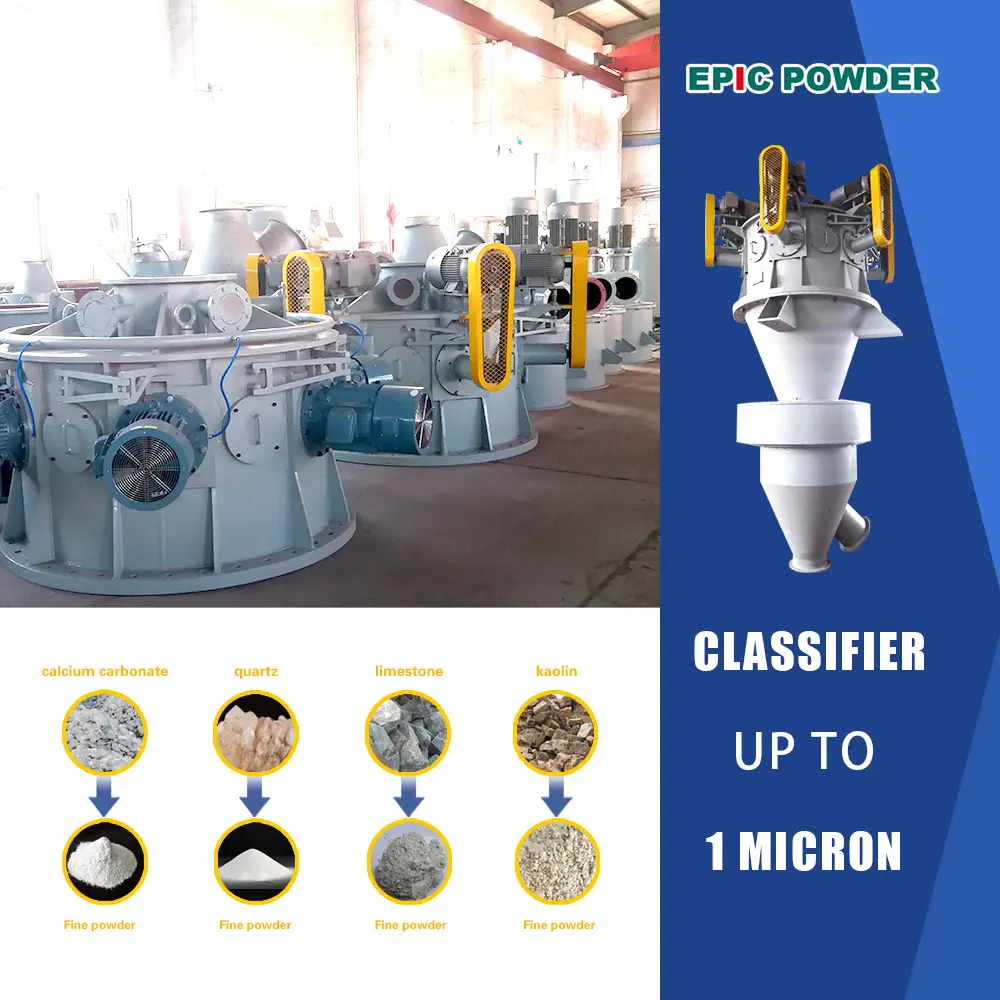
Air classifiers are essential tools in mineral powder processing, especially for materials like wollastonite powder. They work by using the balance between centrifugal force and drag force to separate particles based on size and shape. When powder enters the classifier, the fast-spinning classifying wheel generates centrifugal force pushing coarser particles outward, while finer particles are carried away by the upward airflow due to drag force.
Key components of a turbine air classifier include the classifying wheel, which determines the cut point between fine and coarse fractions; airflow control systems, which adjust the speed and direction of air to fine-tune separation; and the dispersion zone, where powder is evenly spread for efficient classification without agglomeration.
Compared to traditional screening or wet classification, air classification offers several benefits:
- Precise control of particle size cut points allows for consistent separation of ultra-fine wollastonite powder with high aspect ratio preservation.
- A clean, dry process eliminates the need for drying steps.
- Higher efficiency and lower contamination risk compared to wet methods.
This precise separation ensures Wollastonite powder meets strict fineness requirements like D97 of 5-15 μm while maintaining narrow particle size distribution for top-quality end-use performance.
For a deeper dive into the mechanisms, you can explore this detailed overview of the turbo air classifier and its working principles.
Benefits of Air Classification for Wollastonite
Air classification delivers precise control over wollastonite powder classification, offering sharp separation of ultra-fine particles while preserving the critical high aspect ratio of needle-like crystals. This ensures consistent performance in applications requiring fine, acicular fillers without damaging their reinforcing properties.
Key benefits include:
| Benefit | Description |
|---|---|
| Sharp particle separation | Achieves ultra-fine powders with minimal contamination from coarser particles, maintaining acicular wollastonite filler quality. |
| Narrow particle size distribution | Ensures uniformity, improving product reliability and application consistency. |
| High yield of fine fractions | Maximizes recovery of desired fine powder, reducing waste from oversize or undersize fractions. |
| Energy-efficient operation | Uses less power compared to wet classification or sieving, lowering production costs. |
| Low wear & maintenance | Robust design minimizes downtime and extends equipment lifetime. |
| Clean, dry process | Suitable for high-purity wollastonite applications, avoiding contamination from liquids or additives. |
This combination makes air classifiers ideal for ultra-fine wollastonite processing, enabling manufacturers to meet stringent specifications such as D97 fineness between 5-15 μm while preserving needle morphology. For deeper insight into precision dry powder separation technologies, see our detailed air classifier precision dry powder separation solutions.
Using air classification for wollastonite not only refines the particle size but also maintains structural integrity, directly boosting the filler’s strength and performance in composites, paints, and ceramics.
Epic Powder Air Classifiers: Tailored Solutions for Wollastonite
Epic Powder’s HTS series multi-rotor air classifiers are designed specifically to meet the demands of wollastonite powder classification. Their technology ensures sharp, consistent separation — a must for maintaining the needle-like wollastonite structure and achieving narrow particle size distributions.
Key Performance Specs of HTS100/4 for Wollastonite
| Parameter | Value |
|---|---|
| Feed Size | < 325 μm |
| Fine Powder (D97) | 9.05 μm |
| Coarse Powder (D50) | 15.7 μm |
| Output Capacity | 2000 kg/h |
Features That Enhance Wollastonite Processing
- High-speed turbine: Provides precise control for sharp cut points.
- Adjustable airflow: Allows fine-tuning of particle separation to protect the high aspect ratio fibers.
- Robust wear protection: Ensures durability when handling the abrasive, acicular wollastonite powder.
- Multi-rotor design: Offers stable classification performance even at large throughputs.
This setup preserves the ultra-fine wollastonite powder morphology, delivering high yields of premium fines with minimal waste. Customers report excellent needle preservation and consistent size distributions, critical for applications requiring dimensional stability and reinforcement.
For anyone looking to optimize wollastonite separation, the HTS series stands out as a reliable choice. To explore more about how Epic Powder classifiers excel in mineral powder separation and wollastonite grinding and classification, check out their detailed air classifier collections.
Case Study: Successful Wollastonite Classification with Epic Powder Equipment
A leading mineral processor recently upgraded their wollastonite powder classification using the Epic Powder HTS100/4 air classifier. Their goal was to achieve a fine powder with a narrow particle size distribution while preserving the wollastonite’s essential needle-like structure.
Processing Parameters & Results
| Parameter | Before Classification | After Epic Powder HTS100/4 |
|---|---|---|
| Feed Size | 325 μm | 325 μm |
| Fine Powder D97 | 18 μm | 9.05 μm |
| Coarse Powder D50 | Not controlled | 15.7 μm |
| Output Capacity | ~1500 kg/h | 2000 kg/h |
| Aspect Ratio Preservation | Moderate loss | Excellent needle retention |
| Particle Size Distribution | Wide, inconsistent | Narrow, precise |
After classification, the customer saw a dramatic improvement in fineness (D97 reduced from 18 μm to 9.05 μm), which is critical for applications demanding ultra-fine wollastonite powder. The sharp cut point control of the multi-rotor turbine air classifier ensured a highly consistent particle size distribution, reducing coarse fines and waste.
Customer Benefits
- Improved Product Performance: The precise control of particle size enhanced the reinforcement and dispersion quality in plastics and paints.
- Higher Throughput: Output increased by over 30%, boosting production efficiency without sacrificing quality.
- Needle Morphology Preserved: The air classifier’s gentle classification preserved the wollastonite’s acicular shape vital for mechanical strength.
- Cost Savings: Reduced oversize waste cut material loss, improving overall cost-effectiveness.
This case showcases how Epic Powder’s advanced air classification technology can elevate wollastonite powder processing with superior precision and reliability. For those looking to refine mineral powders, their adaptable solutions provide clear advantages.
For more technical insights and classification technology details, check out our article on development of powder classification technology and typical equipment.
Selecting the Right Air Classifier for Wollastonite Processing
Choosing the right air classifier for wollastonite powder classification depends on several key factors. Start by considering your throughput requirements—how much material you need to process per hour—to ensure the classifier can handle your production volume efficiently. Next, identify your target fineness, such as achieving a D97 of 5-15 μm, which directly impacts product performance and market value.
Material hardness and acicular structure also play a role; preserving wollastonite’s needle-like morphology requires gentle yet precise classification. This is why multi-rotor air classifiers, like the Epic Powder HTS series, often outperform single-rotor designs by offering better control over cut points and particle size distribution while maintaining high aspect ratio fillers.
Integrating the air classifier with your grinding mill in a closed-circuit system is another smart move. This setup allows continuous feedback between grinding and classification, minimizing over-grinding and agglomeration. Optimized airflow control and dispersion zones in such systems improve separation efficiency for ultra-fine wollastonite processing.
For best results, always conduct pilot testing and fine-tuning before full-scale operation. Adjust classifier speed, airflow rates, and feed size to strike the ideal balance between yield, fineness, and morphology preservation. For further insight, exploring key factors influencing classification in air classifier mills can enhance your understanding of how to optimize your wollastonite powder processing setup.
By carefully selecting and configuring the right air classifier, you’ll boost product quality, maximize throughput, and ensure consistent performance for your wollastonite applications.
Epic Power
Epic Powder is specialized in fine powder processing technology for mineral industry, chemical industry, food industry, pharama industry, etc.
We are a most professional supplier of powder processing projects, especially powder milling, powder classifying, powder dispersing, powder classifying, powder surface treatment and waste recycling. We supply consultancy, testing, project design, machines, commissioning and training. Contact us today to have you tailored powder solution.

“Thanks for reading. I hope my article helps. Please leave a comment down below. You may also contact EPIC Powder online customer representative Zelda for any further inquiries.”
— Jason Wang, Volunteer